
5 Signs of an Overstimulated Dog (And How to Reset Their Brain)
You took your dog to the dog park for a fun afternoon. Two hours later, you are home, and they are still going. Pacing. Unable to settle. Whining at nothing. Bumping into furniture with a glazed, frantic look in their eyes that you have never seen at the vet or on a calm morning walk.
Your dog is not misbehaving. They are not being stubborn. Their brains are genuinely overwhelmed, and they do not have the tools to bring themselves down from that state without your help.
An overstimulated dog is one of the most misread situations in dog ownership. Owners often mistake it for hyperactivity, disobedience, or just “the zoomies.” In reality, overstimulation is a neurological state, and how you respond to it determines how quickly your dog recovers and whether the problem gets worse over time.
This guide covers the five most important signs of an overstimulated dog, the science behind what is happening in their brain, what triggers overstimulation, and the most effective ways to calm an overstimulated dog and reset their nervous system. The approach here reflects the same training philosophy used at Dan Gentile Dog Training Center in Howell, NJ, where 40+ years of experience with dogs of every temperament has shaped a deep understanding of arousal, threshold, and behavioral regulation.
Quick Overview: Overstimulated Dog at a Glance
Overstimulation in dogs happens when the nervous system takes in more sensory input than it can process and regulate. The result is a dog that looks excited but cannot stop, cannot settle, and cannot respond normally to cues they know well.
The five signs covered in this article:
- Sign 1: Inability to settle, pacing, and restlessness
- Sign 2: Ignoring known commands and losing focus
- Sign 3: Mouthing, nipping, and frantic body contact
- Sign 4: Displacement behaviors such as sniffing, yawning, and sudden spinning
- Sign 5: Excessive vocalization, barking, and whining
Overstimulation Quick Reference Table
| Sign | What It Looks Like | What Your Dog Actually Needs |
| Cannot settle | Pacing, spinning, circling the room repeatedly | Quiet removal from the trigger + rest |
| Loss of focus | Ignores sit, come, and other learned commands | Distance from stimulation + sniff work to reactivate thinking brain |
| Frantic contact | Mouthing, nipping, jumping, body-slamming | Calm, neutral demeanor from owner + redirection to chew toy |
| Displacement behavior | Sudden ground sniffing, yawning, looking away | These are early warning signs; intervene before escalation |
| Excess vocalization | Barking, whining, howling without a clear cause | Remove from environment; do not try to talk the dog down |
Can Dogs Get Overstimulated? What the Science Actually Says
Yes, absolutely. Overstimulation in dogs is not a personality quirk or a training failure. It is a neurological event, and understanding what is happening in the brain makes everything about the condition easier to address.
The Arousal Threshold and the Yerkes-Dodson Curve
Every dog has an optimal arousal zone: a level of stimulation where they are engaged, focused, and performing at their best. Too little stimulation and they are bored and sluggish. The right amount, and they are alert, trainable, and happy.
But push past that optimal zone, and everything changes.
Behavioral scientists describe this through the Yerkes-Dodson Law, which maps the relationship between arousal and performance. As stimulation increases, performance improves up to a peak. Past that peak, additional arousal degrades performance sharply. In dogs, this is the point of overstimulation: the nervous system has more input than it can regulate, and rational decision-making breaks down.
At this point, the logical, problem-solving part of the brain, the cerebral cortex, goes quiet. The survival-driven, reactive part of the brain takes over. The dog is no longer thinking. They are reacting, which is why a well-trained dog suddenly seems to forget every command they know the moment they cross that line.
Arousal Is Cumulative and Takes Time to Clear
One of the most important and least understood facts about overstimulation in dogs is that arousal is cumulative. Each exciting thing that happens does not reset the counter; it adds to it. A car ride, then a crowded parking lot, then an energetic greeting from a stranger, then a dog park; each of these pushes the arousal level higher.
Research on canine arousal indicates that once a dog crosses their threshold, it can take up to 72 hours for their nervous system to return to baseline. That is why an overstimulated dog on Saturday may still be reactive and unsettled on Sunday, even without any new triggers. The tank has not drained yet.
This also explains trigger stacking, a phenomenon where each new stimulus adds to an already elevated arousal state. A dog that handles the dog park fine on an ordinary day may completely fall apart on a day they have already been to the groomer, met new visitors at home, and heard fireworks. The individual triggers were manageable. Together, they pushed the dog over the threshold.
Which Dogs Are Most Susceptible To Overstimulation?
Any dog can become overstimulated. That said, certain dogs hit their threshold faster and come down more slowly than others.
- Puppies and adolescent dogs. Young dogs have not yet developed the neurological self-regulation skills that come with maturity. They are also in active socialization, meaning the world is full of novel, high-stimulation experiences every day.
- High-drive working breeds. Border Collies, Belgian Malinois, Jack Russell Terriers, and similar breeds have nervous systems tuned for high-intensity work. In a family pet context without sufficient structure, they tip into overstimulation easily.
- Rescue dogs with unknown histories. Dogs that experienced early stress, neglect, or inconsistent environments often have lower thresholds and less capacity for emotional regulation.
- Dogs in pain or illness. A dog with an ear infection, joint pain, or recovering from surgery has less bandwidth. Their threshold drops, and things that never bothered them suddenly do.
- Dogs with insufficient daily exercise and enrichment. A dog that never gets adequate physical and mental outlets carries background arousal into every situation. Their threshold is already elevated before anything exciting happens.
The 5 Signs of an Overstimulated Dog
These signs exist on a spectrum. Some dogs show subtle early warnings. Others escalate from zero to fully over-threshold in seconds. Knowing what to look for and catching it early is the difference between a quick reset and a two-day recovery.
Sign #1: Inability to Settle, Pacing, and Restlessness
This is the most visible and consistent sign of overstimulation in dogs. Your dog simply cannot stop moving. They pace from room to room. They circle. They lie down and spring back up within seconds. They cannot find a comfortable position, a comfortable spot, or a comfortable state of mind.
What is happening inside is that the sympathetic nervous system, the fight-or-flight system, is running hot. The body is flooded with cortisol and adrenaline. Muscles are primed. Heart rate is elevated. A dog in this state is physiologically prepared to act, and the pacing is the physical expression of that readiness colliding with having nowhere to direct it.
The critical distinction between normal post-exercise tiredness and overstimulation is time. A tired dog settles within 20 to 30 minutes of coming home and slowing down. An overstimulated dog keeps going. And going. And going. Long past the point where you would expect them to crash.
| What to Watch For: Pacing the same route repeatedly. Circling the coffee table. Lying down and getting up within seconds. Inability to rest even in a familiar, quiet room. Whites of the eyes visible. Pupils dilated even in normal light. |
Sign #2: Ignoring Known Commands and Losing Focus
This one confuses and frustrates owners more than almost anything else. Your dog sits perfectly on command every morning. They come when called reliably in the backyard. Then you take them to a busy environment and suddenly they are looking through you like you do not exist.
They have not forgotten their training. The thinking part of their brain is temporarily offline.
When a dog crosses their arousal threshold, the prefrontal cortex, the part responsible for decision-making, impulse control, and learned behavior, is overridden by the limbic system, which operates on pure instinct and emotion. Asking an overstimulated dog to “sit” is like asking someone in the middle of a panic attack to solve a math problem. The cognitive resource is not available.
This is also why trying to train an overstimulated dog is counterproductive. Repeating commands in a frustrated tone adds more stimulation to an already overloaded system. The dog does not need more input. They need less.
An important side note: a dog refusing treats is one of the clearest indicators they have crossed the threshold. Behavioral science confirms that a dog rejecting food rewards, even high-value ones, indicates that the sympathetic nervous system is so activated that the digestive system is slowing down. Treat refusal equals over-threshold. Every time.
| What to Watch For: Unresponsive to name. Blank stare or glazed eyes. Commands they know perfectly at home get zero response. Snapping treats from your hand roughly or ignoring them entirely. Fixating on a trigger and unable to look away no matter what you do. |
Sign #3: Mouthing, Nipping, and Frantic Physical Contact
A dog that would never dream of putting teeth on a person during a normal walk may start mouthing, nipping, or even biting during or after an overstimulating experience. This is not aggression in the traditional sense. It is arousal leaking out through the most direct physical channel available.
The same goes for frantic jumping, body slamming, spinning into people, and grabbing at clothing or leashes. The dog is not targeting you aggressively. Their nervous system is overloaded and they are discharging that energy through physical contact.
This is one of the most dangerous manifestations of overstimulation, particularly in large, powerful breeds. A dog that is mouthing and nipping due to overstimulation can still cause real injury, and the arousal state makes them far less responsive to correction or redirection than they would normally be.
Children are particularly at risk in these situations. An overstimulated dog around a running, squealing child is a combination of triggers that can escalate from excited mouthing to a genuine bite incident in seconds. Recognizing this sign early and removing the dog from the situation is not overcaution. It is responsible ownership.
| Safety Note: If your dog is mouthing, nipping, or making frantic physical contact with people due to overstimulation, remove them from the situation immediately and calmly. Do not correct them loudly or physically; this adds stimulation to an already overloaded system. Leash them, move them to a quiet space, and allow time to decompress before any interaction continues. |
Sign #4: Displacement Behaviors: Sniffing, Yawning, and Spinning
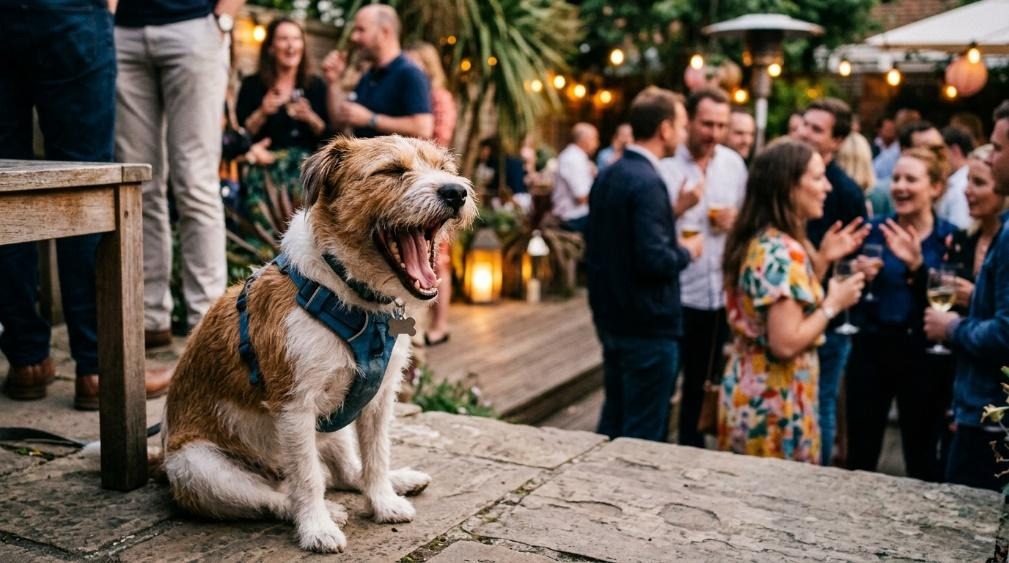
This sign is the one most owners miss entirely, and catching it is enormously valuable because these behaviors appear before the more obvious signs escalate.
Displacement behaviors are things dogs do when they are caught between two conflicting impulses, usually the pull toward a stimulus and the discomfort of being overwhelmed by it. They cannot fully engage and they cannot fully disengage, so they do something seemingly unrelated instead.
Common displacement behaviors in overstimulated dogs include:
- Sudden, intense ground sniffing in the middle of an exciting situation, with the dog’s nose planted on the ground and seemingly oblivious to everything around them.
- Exaggerated yawning that has nothing to do with being tired. A dog that yawns repeatedly during an energetic greeting or a busy walk is communicating stress, not sleepiness.
- Spinning or tail chasing that appears suddenly without obvious cause.
- Scratching at an ear or flank in a context where there is no physical itch to explain it.
- Sudden shaking off as if wet, in a perfectly dry dog. This is actually a neurological reset the dog’s body initiates on its own, and it is a clear signal that arousal just spiked.
- Mounting or humping during play. Widely misunderstood as dominance behavior, this is actually a common displacement behavior when arousal levels get too high. The dog’s body defaults to this behavior as a way to discharge excess energy.
The moment you see these behaviors, your dog is telling you something important: they are approaching their threshold. Act now, before the barking, the nipping, and the inability to settle begin. A quick break, a brief sniff walk, or simply moving away from the trigger gives the nervous system a chance to drop back down.
| What to Watch For: Nose suddenly planted on the ground mid-play. Repetitive yawning during stimulating situations. Spontaneous shaking off. Mounting or humping other dogs or people during high-energy play. Scratching at the body with no apparent physical cause. |
Sign #5: Excessive Vocalization: Barking, Whining, and Howling
An overstimulated dog is a loud dog. The vocalization is not targeted or purposeful the way a dog barking at an intruder is purposeful. It is diffuse, almost compulsive: barking at things that are not there, whining with no apparent object, howling in a car even on familiar routes.
The sound itself reflects the internal state. The nervous system is at full volume, and sound is one of the channels it discharges through.
This type of vocalization is particularly common in the hours after an overstimulating event. You return from a loud party with your dog, and they bark at shadows in the hallway for the next two hours. You come home from the dog park, and they whine at the back door even though you were just outside. The trigger is gone, but the arousal is still running.
Trying to shush, scold, or talk this type of vocalization away does not work and often makes it worse, because your voice is more stimulating going into a system that is already flooded. The answer is not less noise from you. It is less stimulation from the environment entirely.
| What to Watch For: Persistent barking without a visible trigger. Whining that does not correspond to a specific need like food or bathroom. Howling in the car or on familiar, low-stress routes. Barking that continues for extended periods after returning from a stimulating environment. |
How to Calm an Overstimulated Dog: 8 Practical Reset Strategies
Knowing the signs is only half the picture. The other half is knowing what to do the moment you spot them. These eight strategies are ordered from immediate intervention to long-term management. Start with Step 1 and work down.
1. Remove the Dog from the Trigger Immediately
This is the single most effective thing you can do for an overstimulated dog. Get them away from whatever is driving the reaction. Calmly and without drama, leash them and walk them away from the environment, the crowd, the other dogs, the noisy children, whatever it is.
You are not punishing the dog. You are not rewarding bad behavior. You are giving their nervous system the only thing it genuinely needs at that moment: a reduction in input. The faster you remove the stimulus, the faster the recovery begins.
Do not wait for the behavior to escalate before acting. The moment you spot Sign 4, the displacement behaviors, is the ideal moment to begin the removal. Early intervention shortens recovery time significantly.
2. Lower Your Own Energy First
Dogs read human energy with extraordinary sensitivity. If you are frustrated, anxious, or speaking in an urgent, elevated tone, your dog registers that as additional stimulation. Your stress adds to their stress.
Take a breath. Lower your voice. Slow your movements. A calm, neutral, almost boring owner energy is one of the most powerful calming signals you can send. You are not being passive. You are being the regulated presence your dog needs to borrow regulation from.
3. Create a Decompression Space
Every dog should have a designated calm space: a crate they associate with safety and rest, a quiet room, or a specific mat in a low-traffic area of the house. This is not a timeout spot. It carries no negative association. It is simply the place where the nervous system can begin to downshift.
Take your dog to this space when overstimulation is apparent. Sit nearby without engaging them. Keep the lights lower if possible. Reduce sound. Give them time, not interaction. Most overstimulated dogs begin to visibly relax within 10 to 20 minutes in a true decompression environment.
4. Try a Sniff Walk
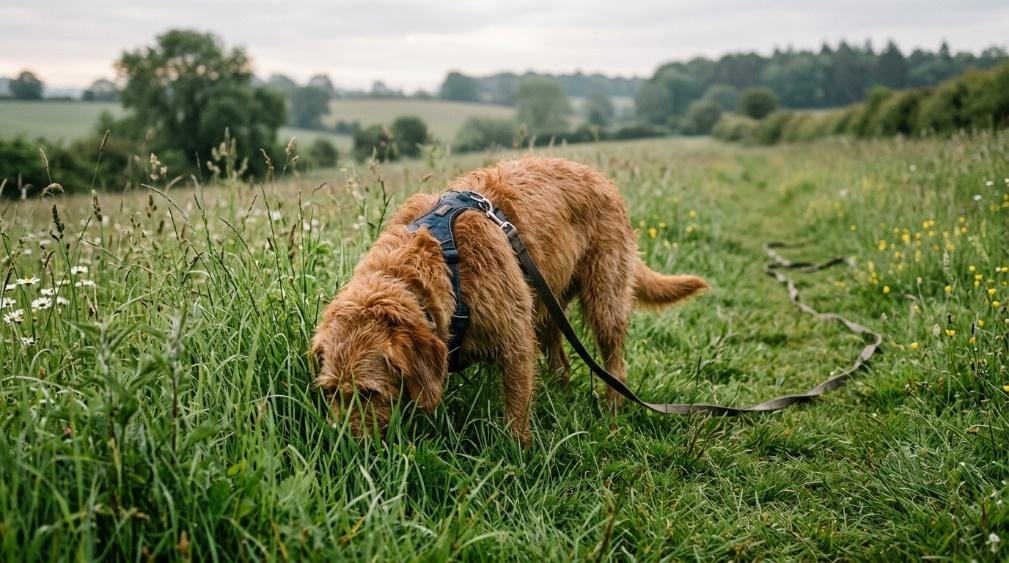
A slow, off-leash-sniff-style walk is one of the most effective brain reset tools available. When a dog sniffs, they engage the olfactory cortex, which is connected to the parasympathetic nervous system, the rest-and-digest system that counteracts the fight-or-flight response driving the overstimulation.
This does not mean a fast, stimulating walk through a busy area. It means a quiet walk in a low-distraction environment where you follow the dog’s nose and let them sniff every blade of grass they want to investigate. No commands, no agenda, no pulling them forward. Ten minutes of this type of sniffing is more neurologically restorative than 30 minutes of exercise for an overstimulated dog.
5. Use Frozen Food Puzzles and Chew Items
Chewing and licking activate the parasympathetic nervous system. A frozen Kong, a lick mat loaded with wet food or peanut butter, a bully stick, or a stuffed marrow bone gives the dog a calm, focused activity that biologically promotes nervous system downregulation.
The key word is frozen. A frozen food item takes significantly longer to consume than a room-temperature treat, extending the parasympathetic activation and giving the arousal level more time to drop. Prepare these items in advance and keep them in the freezer so they are ready when you need them.
6. Practice Passive Calming Exercises
Once the dog is partially settled, passive calming exercises can help bring them the rest of the way down. These are simple, familiar, low-demand behaviors:
- A slow, quiet “down stay” on their mat. Not a trained performance; just a cued rest position held for 30 to 60 seconds with no pressure.
- Gentle massage along the neck and shoulders for dogs that enjoy handling. This activates pressure receptors that signal the nervous system to calm.
- Slow, patterned breathing near the dog. Sitting near them and breathing visibly slowly can entrain their own breathing toward a calmer rhythm.
Do not ask for complex commands or try to run a training session at this stage. The goal is rest, not performance.
7. Protect the Recovery Period
Remember that arousal is cumulative and can take up to 72 hours to fully clear. After a significant overstimulation event, your dog needs protected recovery time. Keep the environment calm. Skip additional stimulating activities for 24 to 48 hours. Shorter, quieter walks. No dog parks, no playdates, no loud gatherings.
This is not a permanent restriction. It is a temporary management strategy that gives the nervous system the time it needs to return to baseline. Coming back too fast with more stimulation prevents the recovery and extends the duration and severity of the overstimulation state.
8. Build Long-Term Threshold Tolerance Through Training
Calming an overstimulated dog in the moment is important. Preventing overstimulation from happening as often and as intensely is the long-term goal.
Consistent obedience training builds impulse control, which directly raises the arousal threshold. A dog that has practiced hundreds of repetitions of calm sits, stays, and focused heeling has stronger neural pathways for self-regulation than a dog with no training history.
Structured obedience training also gives dogs a behavioral vocabulary for situations that previously overwhelmed them. They know what to do with the excitement, and having an action to perform, even a simple sit, gives the brain a productive outlet that keeps arousal from spiraling.
| Pro Tip: The ‘Sniff, Sit, Chew’ Reset Sequence: Three Steps That Work Anywhere. When your dog is starting to show early overstimulation signs, try this quick sequence: move them away from the trigger, ask for a sit and reward it calmly, then give them a chew item. Sniff walk (3-5 min) + sit command + frozen chew = nervous system moving back toward baseline in under 15 minutes for most dogs. |
Common Triggers for Overstimulation in Dogs
Understanding what pushes your specific dog over the threshold lets you manage and prevent overstimulation proactively rather than just reacting to it after the fact. These are the most common triggers.
Dog Parks and Off-Leash Play
Dog parks are one of the highest-risk environments for overstimulation. Multiple dogs, unpredictable energy levels, constant novelty, no structured breaks, and owners who are not always paying close attention create conditions where arousal escalates continuously.
Off-leash play is not inherently bad. The problem is duration and intensity without breaks. A 20-minute structured visit with periodic calm breaks is far better for most dogs than a 90-minute free-for-all. Know your dog’s threshold and leave before they hit it, not after.
Busy Social Gatherings
House parties, family gatherings, holiday celebrations. Multiple new people, food smells, children running, loud talking, and the doorbell ringing repeatedly. Each of these is a stimulus. Together, they are a recipe for a dog to hit their threshold inside of an hour.
The best management strategy for sensitive dogs in these situations is a pre-established calm space with a frozen food item, away from the center of the action. They can join the gathering for short, supervised periods and return to decompress as needed.
High-Arousal Play With Children
Children move fast, make high-pitched sounds, and engage in the exact type of unpredictable, energetic behavior that sends dogs over threshold quickly. A dog that loves children during calm interactions may become overstimulated and start nipping or mouthing during active play.
Structured interaction rules, short play sessions, and regular calm breaks keep the arousal manageable. Never leave dogs and young children together without direct adult supervision, particularly if the dog shows any of the five signs discussed above.
Car Rides and Travel
Cars are stimulating environments: motion, sounds, smells, and the anticipation of arrival at a location the dog associates with excitement. Some dogs become aroused during the car ride itself and arrive at the destination already partially over threshold.
A crate in the car, a window shade to reduce visual stimulation, and calm, quiet behavior from passengers during the drive all help. Avoid letting your dog hang their head out the window on the way to the dog park if overstimulation is already a pattern.
Walks in Overly Stimulating Environments
A busy city street at rush hour, a crowded trail on a weekend morning, or a street fair are very different environments from a quiet neighborhood walk. Dogs that handle their usual route perfectly can hit threshold quickly in an unfamiliar, high-stimulation environment.
Matching the walk environment to your dog’s current arousal state and their established threshold tolerance is one of the most practical things you can do for their long-term well-being.
What Not to Do When Your Dog Is Overstimulated
The instinctive responses to an overstimulated dog are often the worst ones for their recovery. Here is what to avoid.
Do Not Try to Train Through It
Repeating commands in an escalating tone while your dog is over threshold does not teach them anything. There is no cognitive processing available for learning at that moment. All you are doing is adding more noise and frustration to an already overwhelmed system. Training happens below threshold, in calm environments, and gets proofed gradually toward more stimulating ones.
Do Not Match Their Energy
Excited squealing, enthusiastic play, or energetic attempts to redirect an overstimulated dog with toys or games keep the arousal elevated. The goal is de-escalation, and escalating your own energy in response to theirs moves in exactly the wrong direction.
Do Not Use Physical or Verbal Punishment
Shouting at, jerking the leash of, or physically restraining an overstimulated dog adds stimulation and stress to a system that is already past its limit. It does not calm the dog. In many cases, it triggers a defensive or reactive response that worsens the situation. Physical corrections on an over-threshold dog also risk a redirected bite from a dog that is not thinking clearly.
Do Not Force Social Interaction
Some well-meaning owners try to calm an overstimulated dog by having them interact with a calm dog or a patient person. The logic is that the calm presence will transfer. In practice, any new social input, even positive input, adds more stimulation to an already flooded system. Isolation and quiet are what work, not more interaction.
Do Not Immediately Return to the Triggering Environment
A five-minute break at the edge of the dog park and then returning for another 45 minutes is not a reset. It is a brief pause in an ongoing overstimulation event. A genuine reset requires leaving the triggering environment entirely and giving the nervous system meaningful time to recover before exposure begins again.
Preventing Overstimulation in Dogs: Building a Dog That Can Handle the World
Reactive, easily overstimulated dogs are not born that way in most cases. They are created by a combination of genetics, early experiences, and ongoing daily conditions. The good news is that many of those ongoing conditions are completely within your control.
Daily Physical Exercise That Matches the Dog’s Needs
An under-exercised dog carries elevated background arousal into every situation. Their threshold is artificially lowered before anything exciting happens. Regular, appropriate physical exercise, matched to the dog’s age, breed, and energy level, keeps the baseline arousal state at a manageable level.
This does not mean exhausting the dog with hours of fetch or running. Over-exercising a high-drive dog can actually increase arousal over time rather than reduce it. Structured, purposeful exercise followed by genuine rest produces better results than endless high-intensity activity.
Daily Mental Enrichment
A dog whose brain gets daily work through training sessions, food puzzles, nose work, and structured play has stronger impulse control and better capacity for self-regulation than a dog who spends eight hours a day with nothing to do.
Mental enrichment is genuinely different from physical exercise in its neurological effect. Activities that engage the olfactory system and the problem-solving cortex, such as sniff games, training, and puzzle feeders, promote parasympathetic activation, the calm state. High-intensity physical exercise promotes sympathetic activation, the alert state. Both have a role; balance is the goal.
Consistent Obedience Training
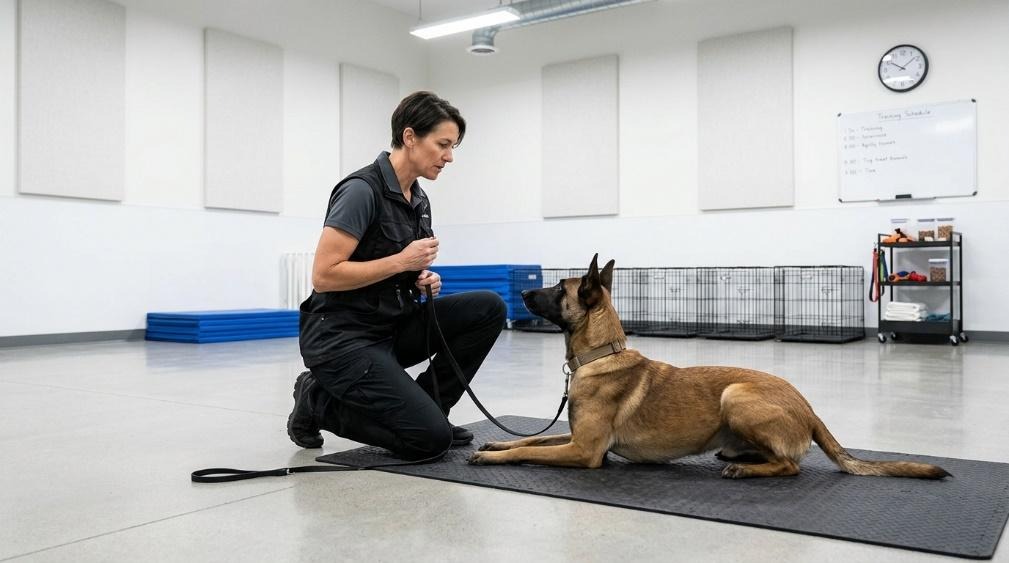
This is the most underrated prevention tool for overstimulation. Dogs that have practiced hundreds of repetitions of calm, focused behavior under the guidance of a skilled trainer have structurally different neural pathways than untrained dogs. They have practiced self-regulation literally thousands of times, and it shows in their ability to stay under threshold in situations that would tip an untrained dog over the edge.
This is particularly true of dogs that go through structured board and train programs. The immersive environment builds not just command response but genuine impulse control and emotional regulation, the two skills that determine how well a dog handles stimulating environments.
Gradual Desensitization to High-Stimulation Environments
Dogs learn to tolerate stimulating environments by being exposed to them in a controlled, gradual way that keeps them below threshold the entire time. Start at the edge of the dog park, not inside it. Stand near the busy street, not on it. Enter the crowded store for two minutes, not twenty.
Each successful below-threshold exposure builds tolerance. Each over-threshold experience in the same environment does the opposite: it reinforces the aroused response and lowers the threshold for that trigger. Build gradually and protect the early exposures from escalating.
How Dan Gentile Dog Training Center Helps Overstimulated Dogs in Monmouth County
Overstimulation and impulse control issues are among the most common reasons owners in Monmouth County, NJ and beyond reach out to Dan Gentile Dog Training Center in Howell Township. It is also one of the areas where professional training produces the most dramatic and lasting improvements.
| 40+ Years of Experience With Arousal and Threshold Issues: Seen It All, Fixed Most of It. Dan Gentile has worked with thousands of easily overstimulated, reactive, and high-drive dogs across 40+ years of professional training. The patterns are familiar, and the solutions are well-established. When you bring an overstimulated dog here, you are not a first case or an unusual situation. You are working with someone who has navigated this exact profile hundreds of times. |
| The Train While Boarding Program: Immersive Structure That Rewires the Arousal Response. The flagship board and train program works so well for overstimulated dogs precisely because immersion changes neural pathways in ways that weekly one-hour sessions cannot. In a structured training environment over two to three weeks, dogs build genuine impulse control and emotional regulation through hundreds of daily repetitions. The 12-acre facility in Howell Township gives dogs the calm, distraction-controlled environment they need to learn to settle, focus, and stay below threshold. |
| Habit Correction Training for Complex Cases: When Overstimulation Is Part of a Bigger Picture. Some dogs combine overstimulation with reactivity, anxiety, resource guarding, or aggression. These multi-layered behavior profiles require a systematic behavior modification approach, not just obedience commands. Dan’s team identifies the root drivers and builds a targeted plan. |
For dogs with reactive and anxiety-based behavior patterns layered on top of their stimulation sensitivity, the behavior modification program addresses what standard obedience training alone cannot.
| Owner Education at Every Step Because the Dog Goes Home Eventually. Every program includes owner instruction at pickup and free lifetime consultation support. Knowing how to read your dog’s displacement behaviors, when to leave the dog park, and how to structure a recovery period after overstimulation are skills that prevent problems from recurring. Dan’s team teaches you to be the calm, consistent presence your dog’s nervous system is looking for. |
| Puppy Programs That Build Threshold Tolerance Early: Prevention Is Better Than a Crisis. The best time to build a dog’s capacity for handling stimulating environments is during puppyhood, before overstimulation patterns become entrenched. Dan’s puppy training program introduces structure, socialization, and impulse control during the optimal developmental window, producing dogs that handle the world with confidence rather than overwhelm. |
Call (732) 938-5040 to schedule a free consultation, or contact Dan Gentile Dog Training Center online. You can also explore the puppy training program and the full obedience training options to find the right fit for your dog’s needs.
FAQ: Overstimulation in Dogs
How do I know if my dog is overstimulated or just excited?
Excitement and overstimulation look similar early on but diverge quickly. An excited dog can still respond to their name, take treats, and come down from the energy within a reasonable time. An overstimulated dog cannot settle, ignores commands they know well, refuses treats, and stays in that elevated state well past when you would expect them to relax. The inability to come down on their own is the defining feature of overstimulation.
Can overstimulation in dogs cause long-term problems?
Repeated overstimulation that is not managed can lower a dog’s arousal threshold over time, meaning it takes less and less to push them over the edge. It can also strengthen neural pathways associated with reactive, frantic behavior, making those patterns more automatic and harder to interrupt. This is why consistent management and training are important, not just for immediate comfort but for the dog’s long-term behavioral health.
My dog seems fine during the stimulating event but falls apart afterward. Why?
Arousal is cumulative and has a lag. A dog that appears to be coping during a party or a dog park visit may actually be banking arousal the entire time without showing visible signs until they get home and the adrenaline starts to clear. This pattern, sometimes called ‘trigger stacking hangover,’ is very common and is why protective recovery time after stimulating events matters even when the dog seems fine during the event itself.
Is overstimulation the same as anxiety?
They are related but distinct. Overstimulation is a state of nervous system overload that can affect any dog, including confident, happy ones. Anxiety is a chronic emotional state characterized by persistent worry and anticipation of threat. Some anxious dogs have lower arousal thresholds and become overstimulated more easily, but an overstimulated dog is not necessarily an anxious one. If your dog shows signs of anxiety beyond just overstimulation episodes, a behavior modification program or a consultation with a veterinary behaviorist is worth pursuing.
How long does it take an overstimulated dog to calm down?
It depends on the severity of the overstimulation and the dog’s individual recovery rate. Mild overstimulation with early intervention can resolve in 15 to 30 minutes of genuine quiet. Severe over-threshold events can take 24 to 72 hours for full nervous system recovery. During that recovery window, avoid additional stimulating activities and keep the dog’s environment as calm and predictable as possible.
Should I get professional help for an overstimulated dog?
Professional training is strongly recommended if your dog’s overstimulation is happening regularly, escalating in severity, involving nipping or biting, making walks or social situations difficult to manage, or persisting despite your best management efforts at home. A professional trainer can identify your dog’s specific threshold triggers, build a systematic desensitization and training plan, and give you the handling skills to manage arousal before it becomes a crisis.
Your Overstimulated Dog Is Not a Bad Dog. They Need a Reset.
The five signs of an overstimulated dog, the inability to settle, loss of focus, frantic physical contact, displacement behaviors, and excessive vocalization, are not personality flaws and they are not training failures. They are the observable output of a nervous system that has taken in more than it can regulate.
Understanding this changes how you respond. Instead of frustration, you bring calm. Instead of more commands, you provide less stimulation. Instead of waiting for the behavior to stop on its own, you actively create the conditions for recovery: a quiet space, a sniff walk, a frozen chew item, and time.
The long-term picture is equally manageable. Dogs that get consistent obedience training, adequate daily exercise and enrichment, and gradual, controlled exposure to stimulating environments build real threshold tolerance over time. They handle the world better not because the world got less stimulating, but because their nervous system learned to stay regulated within it.
If you are in New Jersey and your dog’s overstimulation is beyond what home management alone is addressing, the team at Dan Gentile Dog Training Center in Howell Township is ready to help. With 40+ years of experience, a proven board and train program, and a deep understanding of canine arousal and impulse control, there is no better place in Monmouth County to get your overstimulated dog the structured support they need.
Call (732) 938-5040 for your free consultation today.