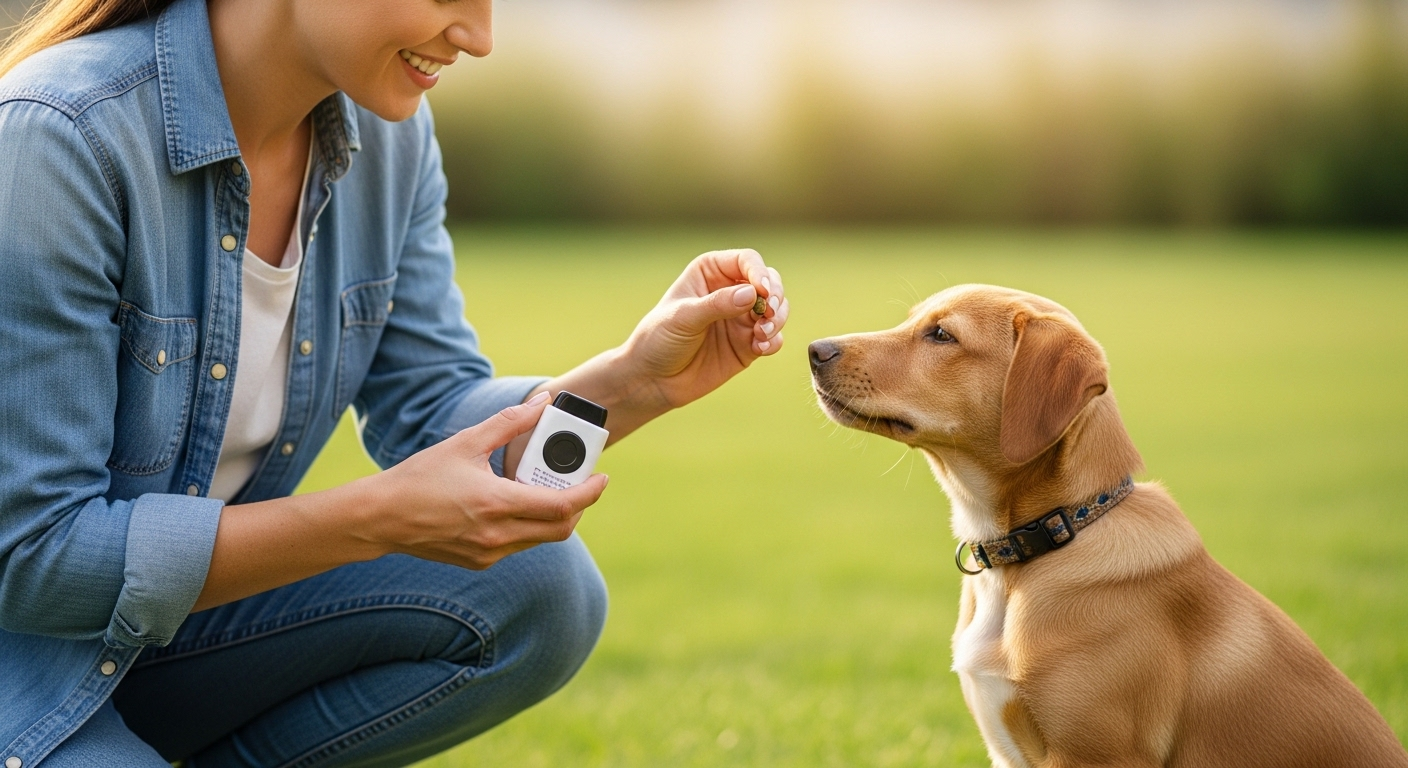
How to Use a Clicker to Train a Dog: A Simple Guide
It feels like you are speaking two entirely different languages. You say “sit” and your new puppy just stares at you blankly or runs away with your favorite shoe. Training a new dog can feel incredibly frustrating when your timing is off. They do not speak English. They need a clear, consistent signal. If you want a fast and reliable way to communicate, learning how to use a clicker to train a dog is the ultimate game-changer.
Quick Answer: How to Use a Clicker to Train a Dog
Learning how to use a clicker to train a dog requires clear communication and perfect timing. Follow these exact steps for the fastest results:
- Charge the clicker: Press the button and immediately hand your dog a high-value treat. Repeat this 20 times so they learn the sound always equals a reward.
- Lure the behavior: Use a piece of food in your hand to physically guide your dog into a position, such as a sit.
- Click at the exact moment: Press the clicker the split second your dog’s bottom hits the floor.
- Deliver the reward: Give your dog the treat immediately after you make the click sound.
- Add the command: Once they understand the physical motion, say the word “Sit” clearly right before you lure them.
What is the Clicker Training Method?
The clicker training method is a science-based system of positive reinforcement. Instead of pushing your dog into a sitting position or pulling on their leash, you let them make choices. When they make the right choice, you mark that exact moment with a distinct sound.
Dan Gentile has spent 40 years testing different behavioral methods. Trends come and go on the internet constantly. But marker training stands the test of time because it is rooted in clear, fair communication.
It builds a dog’s confidence rather than breaking its spirit. The dog becomes an active participant in the learning process. They actually want to figure out what earns the click.
The Science Behind the Click: Understanding Operant Conditioning
Clicker training is rooted in operant conditioning, a method pioneered by psychologist B.F. Skinner in the 1960s. Skinner observed that an animal naturally repeats an action that leads to a positive consequence, such as receiving food (a primary reinforcer).
The clicker serves as a “conditioned reinforcer”. It produces a distinct, emotionally neutral sound that is completely different from human voices, which can constantly vary in tone and volume. The click acts as a precise marker, bridging the gap to tell your dog exactly which behavior earned the treat by pairing this unique sound with a reward.
How Does Clicker Training Work?
Why not just say “good boy”? The answer comes down to consistency. Human voices change constantly. We talk on the phone. We yell across the house. Our tone changes depending on our daily mood.
A clicker sounds exactly the same every single time. It cuts through the background noise of your busy living room.
It works by creating a powerful mental association. The dog learns that the sharp, unique sound predicts a highly valuable reward. Because the click is so fast, it pinpoints the exact physical movement you want to reinforce.
If your dog jumps up, but you click the millisecond all four paws hit the floor, your dog quickly realizes that keeping their feet on the ground is what pays off.
3 Steps on How to Use a Clicker to Train a Dog
Step 1: Charging the Clicker (Your First Lesson)
Before you can teach your dog any actual tricks, they need to know what the sound means. We call this “charging” or “loading” the clicker. This is the absolute beginner step.
- Grab a handful of high-value treats like tiny pieces of hot dog or string cheese.
- Press the button to make the click sound.
- Immediately hand your dog one treat.
- Repeat this 15 to 20 times in a quiet room.
Do not ask them to sit or stay yet. You just want them to realize that the sound always equals free food. You will know they understand the game when you click the button and they immediately snap their head around to look at your hand.
Step 2: How to Use a Clicker to Train a Dog to Sit
Now that the sound has real value, you can start shaping their behavior. Let us start with a basic sit.
- Hold a treat right in front of your dog’s nose.
- Slowly lift the treat up and back over their head.
- As their nose goes up to follow the food, their bottom will naturally hit the floor.
- At the exact moment their bottom touches the floor, press the clicker.
- Hand them the treat.
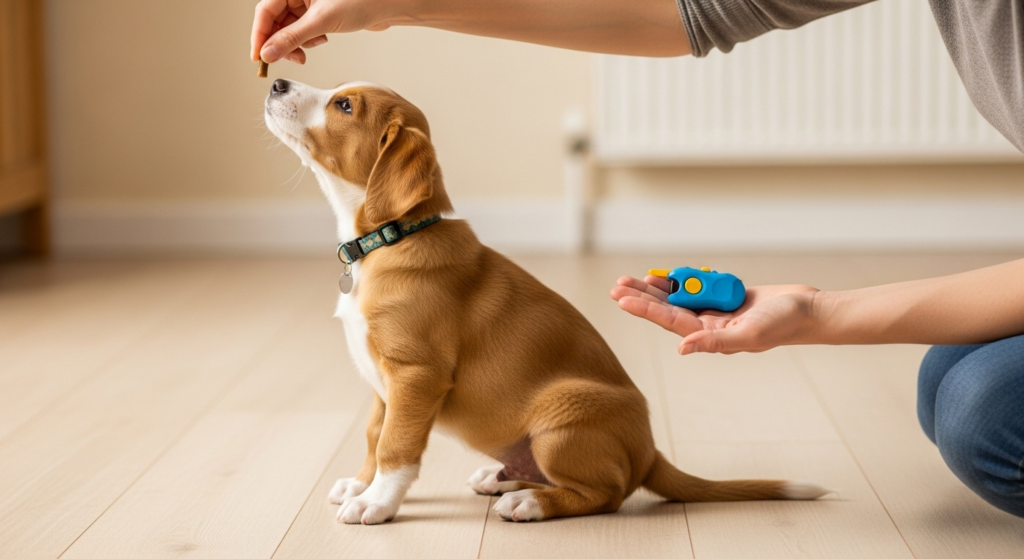
Timing is everything here. If you click after they stand back up, you just accidentally rewarded them for standing up. You must mark the exact moment of the sit.
Step 3: Adding the Command Words
You do not want to lure your dog with a piece of food in your hand forever. Once your dog is reliably following your hand into a sitting position, you can add the actual word.
Say the word “Sit” clearly once. Use your hand motion to guide them down. Click the exact moment they sit. Reward them with the treat. Soon, your dog will hear the word and sit automatically before you even move your hand.
While luring with a treat is a great way to start, the most advanced way to use a clicker is called capturing. Capturing means you wait for your dog to naturally perform a desirable behavior on their own, and you immediately click and reward it. For example, if your dog naturally chooses to lie down calmly on their bed instead of pacing around the kitchen, instantly click and toss them a treat. You are “capturing” their calm state of mind. By doing this, you are teaching the dog that making good choices on their own without needing a command is highly rewarding.
You do not want to carry a clicker in your pocket for the rest of your dog’s life. The clicker is strictly a teaching tool used during the acquisition phase of a new command. Once your dog reliably understands what “Sit” or “Down” means, you must fade the clicker out. You do this by moving to a variable reward schedule, meaning you only click and reward occasionally, rather than every single time. This keeps the dog eager to please and transitions their obedience from a food-driven transaction into a habit based on respect.
Bridging the Gap: Training at a Distance and Building Duration
One of the greatest advantages of using a clicker is its ability to “bridge” the gap in time between your dog’s correct behavior and the delivery of the actual reward. For example, if you are training your dog to jump through a hoop or stay on their bed from across the room, you cannot physically hand them a treat fast enough before they break the command.
The sharp sound of the clicker solves this by marking the exact correct moment, telling your dog that they succeeded and the reward is on its way, even if it takes you a few seconds to walk over and deliver it. Once your dog reliably responds to the cue, you can gradually withhold the click for longer periods to build their duration and impulse control
What if My Dog Doesn’t Do What I Ask?
Do not get frustrated. If your dog stops listening or makes a mistake, do not repeat the command ten times. Dogs do not naturally want to ignore you. If they fail, it usually means the training environment is too difficult.
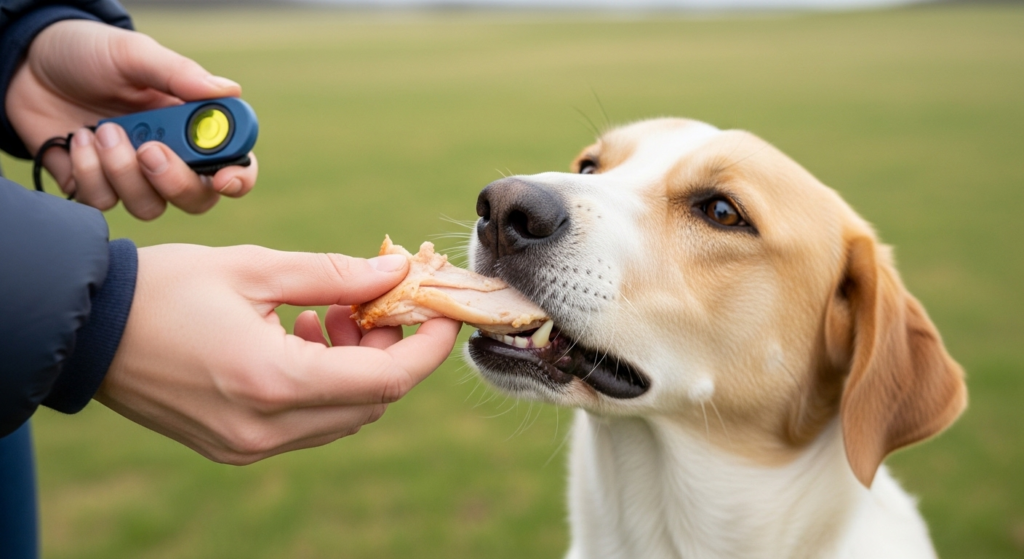
Take a step back and evaluate the situation. Are you trying to train them right next to the heavy traffic on Route 9? If so, the environment is too distracting. Move back to a quiet room. Are you using dry kibble? Try upgrading to a much higher-value treat, like real chicken. Keep your training sessions very short. Five minutes of highly focused, successful training is much better than an hour of frustration.
Common Clicker Training Roadblocks
Even when following the steps, owners sometimes run into a few common roadblocks. Understanding how to troubleshoot these issues is key to fast learning:
- The dog only listens when they see the clicker: This often happens if your dog learns to associate the visual sight of the tool with the cue, rather than the sound itself. To fix this, practice using the clicker hidden inside your pocket or behind your back so your dog is forced to focus on your verbal or hand cue rather than the tool.
- The dog gets too overly excited: Enthusiasm shows your dog is motivated, but if they get overexcited, use it as an opportunity to build impulse control. Simply wait calmly for the dog to naturally settle down, then instantly click and reward that calm state of mind.
- Your mechanical timing is off: If you struggle to click at the exact millisecond your dog performs the action, your dog will get confused. Practice your timing mechanics without your dog first. Have a friend or family member perform a repeatable action, like bouncing a ball or clapping, and practice clicking at the exact moment the action happens to sharpen your own reflexes.
- The dog loses interest in treats: If your dog isn’t motivated by the food you are offering, experiment with higher-value rewards like cooked chicken or cheese, or try training before meals when they are naturally hungry
What Other Things Can I Teach My Dog?
Once your dog understands the clicker game, the possibilities are endless. You can use this exact same method to teach them how to walk politely on a leash without pulling. You can click and reward them for coming when called. You can even use it to teach complex behavioral tricks like going to a specific bed when the doorbell rings.
You can dive deeper into these advanced marker techniques on our dedicated dog clicker training page. The core concept remains the same for every single trick. Mark the right choice, reward the dog, and repeat.
Clicker training in your living room is a fantastic way to establish communication. However, severe behavioral issues or intense leash reactivity often require more than just a clicker. This is where our immersive Train While Boarding program steps in. We take the foundation of clear communication and apply it to a highly structured, distraction-proof environment. Please note: Our formal behavioral programs are designed for dogs starting at a minimum of 3.5 to 4 months old, and we focus on advanced obedience rather than house training guarantees.
Master Your Timing With the Local Experts
Practicing in a quiet living room is easy. Getting your dog to listen when there are massive distractions outside is the real test. This is where professional, hands-on guidance makes a huge difference.
At the Dan Gentile Dog Training Center, we bring over four decades of real-world experience to every single lesson. We do not just train dogs. We train owners. You can read exactly how we teach these foundational communication skills in our Dog Training Program in Monmouth page.
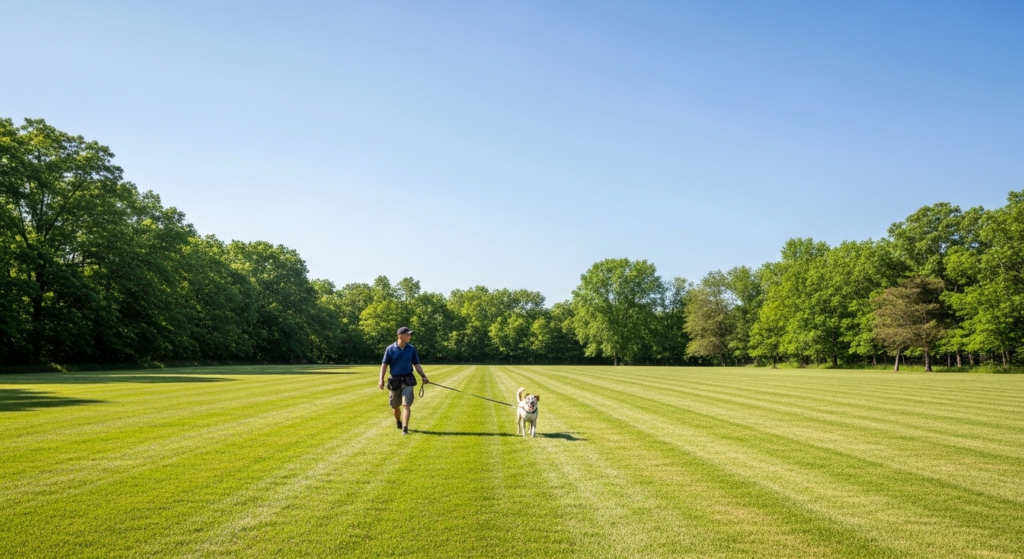
We take you out of the crowded pet stores and bring you onto our massive private property. You can see the space for yourself on our Dog Training Center in New Jersey page. Practicing on our 12-acre Howell Township campus gives you the perfect safe environment to master your timing. We show you exactly how to handle real-world distractions safely before you try it in your own neighborhood.
Frequently Asked Questions on How to Use a Clicker to Train a Dog
Do I have to carry a clicker and treats forever?
No. The clicker is strictly a teaching tool used to build a new behavior. Once your dog fully understands a command like “sit” or “stay,” you fade the clicker out completely. You will eventually replace the constant food rewards with real-world praise, like a scratch behind the ears or throwing a favorite ball.
Can I clicker train an older dog?
Absolutely. You can always teach an old dog new communication skills. We successfully train adult and senior dogs every single week here at our Howell Township campus. Older dogs actually love the mental stimulation that marker training provides. It is never too late to start.
What happens if I click at the wrong time by mistake?
Do not panic. A single badly timed click will not ruin your dog. Just hand them the treat anyway. A click must always equal a reward to keep the tool valuable and maintain their trust. Simply reset your position, take a breath, and try the exercise again with better timing.
Do you teach these methods at your training center?
Yes. Dan Gentile brings 40 years of hands-on experience to every custom training plan. We teach local owners exactly how to master marker training right here in Monmouth County. Whether you need help with basic obedience or severe behavioral issues, we show you the exact timing secrets that make learning incredibly fast for your dog.
Learning how to use a clicker to train a dog takes practice. If you hit a roadblock, we are right here for you. Our proven methods have helped thousands of local families across Monmouth County, Ocean County, and the entire Tri-State area.
You can read incredible stories from owners who mastered their communication skills on our Testimonials page. Real results prove that anyone can build a reliable companion with the right guidance. Call us today at (732) 938-5040 to schedule a consultation at our Howell campus.