Dog Food Aggression: What It Really Is, Why It Happens, and How to Handle It Safely
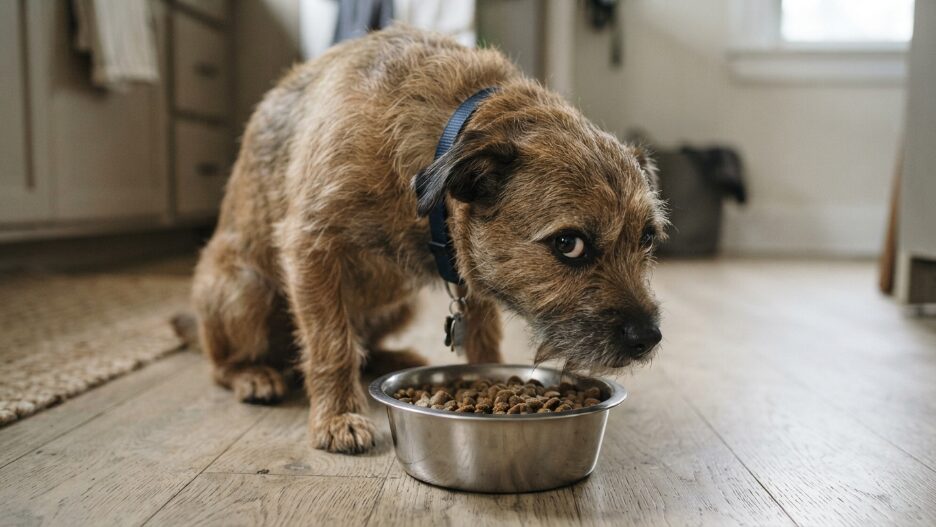
You set the bowl down. Your dog drops their head and freezes. You reach toward the bowl to add a bit more kibble, and you hear it: a low rumble, deep and deliberate, a sound that stops you cold.
If that scene is familiar, you are dealing with dog food aggression. And you are not alone. It is one of the most common behavior issues dog owners report and one of the most mishandled. People either ignore it, hoping it will pass on its own, or they try to “dominate” their way through it and make it significantly worse.
Food aggression in dogs is not a character flaw, and it is not a sign that your dog is bad or dangerous in a broad sense. It is a deeply instinctual behavior rooted in millions of years of canine survival strategy. Understanding that does not make it acceptable, but it does change how you approach it.
This guide covers food aggression in dogs from the ground up: what it is, why it develops, what the warning signs look like before the growl, how to handle it safely at home, when to call in a professional, and what to do if your dog is food aggressive with other dogs.
The information here reflects the same evidence-based training philosophy practiced at Dan Gentile Dog Training Center in Howell Township, NJ, where over 40 years of working with dogs of every temperament has shaped a practical, honest understanding of resource-based behavior.
Quick Overview: Dog Food Aggression at a Glance
Food aggression is a specific form of resource guarding in which a dog uses threatening behavior to protect food from perceived competition. It exists on a spectrum from mild (eating faster when approached) to severe (biting without warning).
The key facts every owner should know:
- Food aggression is natural, but not acceptable. Guarding food is hardwired into the canine brain. That does not mean it should be tolerated or left unaddressed.
- It can escalate without intervention. Mild food aggression that goes unaddressed does not stay mild. The behavior tends to intensify over time and can expand to other resources.
- Punishment makes it worse. Yelling, hitting, or forcibly taking food away does not resolve food aggression. It increases fear and anxiety around food, which fuels the behavior.
- Early warning signs appear before the growl. Most owners do not notice food aggression until they hear a growl. The actual warning signs start much earlier and much more subtly.
- Management and training work together. You cannot train your way out of food aggression without also managing the environment. Both are required.
- Severe cases need professional help. If your dog has already snapped or bitten over food, home training alone is not sufficient or safe. A credentialed professional is the right call.
Food Aggression Severity Scale: What Each Level Looks Like
| Level | Observable Behaviors | Recommended Response |
| Mild | Eats faster when approached, hunches slightly over bowl | Prevention exercises, controlled mealtime protocol |
| Moderate | Stiffens, hard stare, low growl, whale eye | Management + desensitization/counter-conditioning with professional guidance |
| Severe | Snapping, lunging, attempting to bite when approached | Professional behavior specialist required; strict management in the meantime |
| Extreme | Has already bitten a person over food; biting without clear warning | Certified Applied Animal Behaviorist or veterinary behaviorist immediately |
Food Aggression in Dogs Is Not What Most People Think It Is
The term “food aggression” makes people think of dangerous dogs. The reality is both more ordinary and more nuanced than that.
Food aggression in dogs is a subset of resource guarding: a broad behavioral category in which a dog protects something they value from perceived competition. The resource can be food, toys, resting spots, a specific person, or even a location. Food is simply the most commonly guarded resource because food is, in evolutionary terms, the most critical.
Thousands of years before dogs ate from ceramic bowls on a schedule, their ancestors survived on a feast-or-famine model. Food was unpredictable. Competition for it was real. The dog that guarded its meal aggressively ate more, stayed stronger, and reproduced more successfully. Food guarding was not a behavioral problem then. It was a survival advantage. That instinct did not disappear when humans started providing three meals a day.
Why Some Dogs Develop It and Others Never Do
Not all dogs develop food aggression. Genetics plays a role: some breeds and individual bloodlines are predisposed to higher resource-guarding tendencies. But genetics is only part of the picture. Several environmental factors reliably contribute to the development of food aggression, and understanding them is useful for both prevention and treatment.
Dogs that grew up in litter environments where puppies competed for food from a communal pan often arrive in homes with already-established guarding instincts. The puppy who ate fastest and pushed hardest got the most. That lesson becomes neural wiring.
Dogs from shelters, especially those that spent extended time in high-density kennels, frequently develop or intensify food guarding. Scarcity, real or perceived, triggers the behavior. Once the nervous system learns that resources are at risk, it does not easily unlearn that lesson, even when the threat is long gone.
Ironically, some dogs develop food aggression because of well-meaning owner behavior. Repeatedly taking food or items away from a dog to “establish dominance,” putting a hand in the food bowl while the dog eats to teach them “I control the food,” or interrupting meals with unnecessary handling can teach a dog that a human approaching during mealtime means the food is about to disappear. The dog responds by guarding harder. The owner escalates. The cycle worsens.
Medical Causes: When Food Aggression Appears Out of Nowhere
A dog that suddenly develops food aggression after years of relaxed mealtime behavior deserves a veterinary evaluation before any training begins. Pain, particularly dental pain, gastrointestinal discomfort, or neurological changes, can dramatically lower a dog’s threshold for guarding behavior.
Thyroid dysfunction, cognitive dysfunction syndrome in older dogs, and certain medications can also produce behavioral changes that present as increased aggression around food. If the onset was sudden and there was no obvious trigger event, rule out medical causes first. Training cannot fix a pain response.
Recognizing Dog Food Aggression Before the Growl: Early Warning Signs Most Owners Miss
Most owners do not recognize food aggression until they hear or see something obvious: a growl, a snap, or a lunge. By that point, the behavior has typically been developing for weeks or months. The earlier you can read the signs, the earlier you can intervene, and early intervention is always more effective than late correction.
Here are the signals, ordered from earliest to most severe. Watch for any of them the next time you approach your dog during a meal.
Stage 1: Subtle Changes You Can Easily Miss
- Eating speed increases. A dog that eats faster when someone approaches the bowl is showing the earliest form of food aggression. They are trying to consume the resource before the competition can take it.
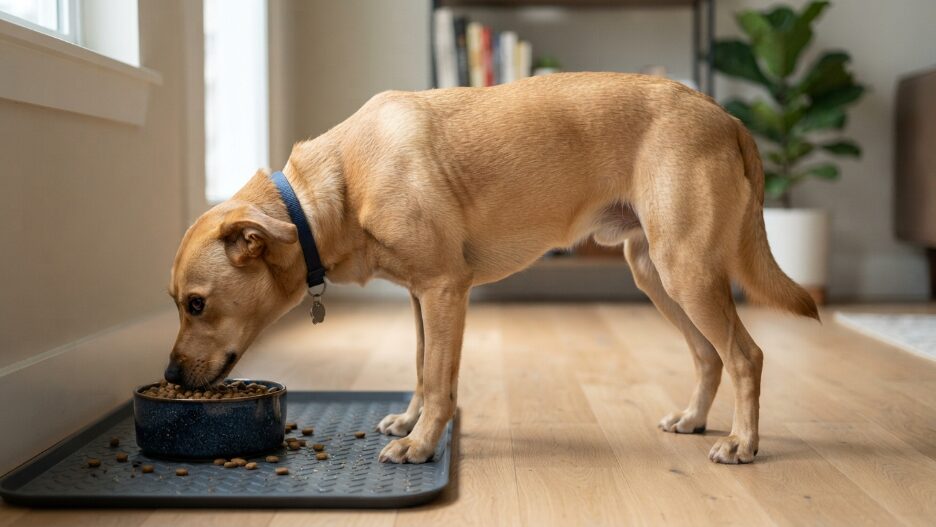
- Body posture shifts. The dog curves their body over the bowl, head drops lower, shoulders round forward. This is called “covering” or “hunching,” and it is an attempt to use the body to shield the food.
- Stillness. Brief pauses in eating when someone approaches, with the dog’s head staying low and the body going very still. This is a freeze response, the dog deciding whether to escalate.
- Tail position change. The tail drops, stiffens, or tucks. A dog eating happily typically has a relaxed, neutral tail. A dog entering a guarding state shows clear tail tension.
Stage 2: Clearer Warning Signals
- Hard eye or whale eye. The dog turns their head slightly away from you while keeping their eyes locked on you. The whites of the eyes become visible around the edges. This is called whale eye and it is a reliable stress and threat signal.
- Lip lifting. A subtle curl of the lip, often on one side. Easy to miss in short-coated dogs, more visible in breeds with prominent muzzles. It is the body preparing for a display of teeth.
- Low growl. Continuous, low, and directed. Different from a play growl in its steadiness and intention. This is a clear communication: you are too close, back up.
- Raised hackles. The hair along the spine rises, particularly over the shoulders. This can appear without growling and is a reliable indicator of elevated arousal.
Stage 3: Escalation
- Snapping or air snapping. A snap that does not make contact is a warning shot. The dog is telling you that the next step is contact. Do not interpret a near-miss snap as “not that bad.” It is one repetition away from a bite.
- Lunging. Forward movement toward an approaching person with the intent to create distance. At this stage, the dog is no longer just warning. They are actively driving the perceived threat away.
- Biting. Contact biting over food represents severe food aggression and requires immediate professional evaluation. The dog has learned that escalating to a bite is effective, and that lesson is very difficult to reverse without expert help.
| A Note on Growling: Never punish a growl. This is critical and frequently misunderstood. A growl is communication. It is your dog telling you, as clearly as they can, that they are uncomfortable. A dog that is punished for growling does not stop being uncomfortable; they stop warning you before they bite. The goal is not a dog that does not growl. It is a dog that does not feel the need to. |
How to Stop Food Aggression in Dogs: A Step-by-Step Approach That Actually Works
There is no single-session fix for food aggression. What works is a combination of environmental management, controlled mealtime protocols, and a systematic behavior modification process called desensitization and counter-conditioning. These are the same principles used by certified trainers and behaviorists across the country.
Work through these steps in order. Do not skip ahead. Rushing the process is how people get bitten.
Step 1: Rule Out Medical Issues First
If food aggression appeared recently or intensified suddenly, schedule a veterinary appointment before doing anything else. Pain, illness, and hormonal changes all affect aggression thresholds. You need to know what you are working with before you begin any behavior modification program.
Step 2: Stop All Behaviors That Make Food Aggression Worse
Before you can improve the situation, you need to stop the things that are currently making it worse. These are the most common owner behaviors that escalate food aggression, often unintentionally:
- Reaching into or hovering over the food bowl while the dog eats. This is perceived as competition or threat. Stop immediately.
- Taking the food bowl away mid-meal to establish dominance. This confirms the dog’s fear that resources will be stolen and reliably increases guarding intensity.
- Punishing the growl. Scolding, hitting, or spraying a dog for growling over food removes the warning signal and produces a dog that bites without notice.
- Allowing children to approach the dog during meals. Until food aggression is fully resolved, feeding should happen in a managed, controlled setting with no children present.
- Free feeding. Leaving food down all day gives the dog constant access to the guarded resource and constant opportunity to practice guarding behavior. Move to scheduled, structured mealtimes.
Step 3: Build a Safe Mealtime Management Protocol
Management does not fix food aggression, but it prevents incidents while training is in progress. These management steps are non-negotiable until the behavior is fully resolved.
- Feed in a separate, contained space. A crate, a separate room with the door closed, or behind a baby gate removes the opportunity for guarding incidents involving other people or animals.
- Use a consistent mealtime structure. Ask for a sit before placing the bowl down. Put the bowl down and walk away. Let the dog eat undisturbed. Remove the bowl when they walk away from it, not while they are still eating.
- Feed multiple small meals rather than one large one. A dog that is less hungry at each meal has less biological urgency driving the guarding response.
- Never allow anyone to tease, handle, or approach a food-aggressive dog during meals. Brief every visitor, houseguest, and family member.
Step 4: Teach Your Dog That Approaching Humans Mean More Food Is Coming
This is the core of desensitization and counter-conditioning for food aggression. The goal is to change the dog’s emotional association with a person approaching during mealtime from “threat to the resource” to “something good is about to happen.”
Start at a distance where the dog shows zero guarding signals. For many dogs with established food aggression, that is six to ten feet away from the bowl. This is their threshold distance, the point beyond which the guarding response activates.
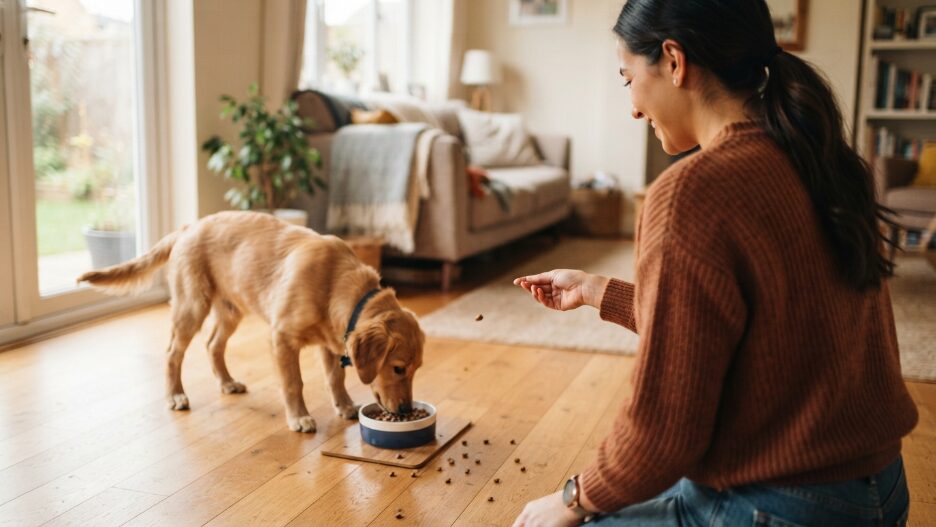
- Stand at least six feet from the dog while they eat. Toss a high-value treat (chicken, cheese, hot dogs) in the general direction of the bowl without stopping moving. Walk past, toss, keep going. Repeat several times per meal over several days.
- Watch the dog’s body language closely. If they stiffen, pause eating, or show any warning signal, you are too close. Increase your distance.
- If the dog continues eating normally and begins to look up in anticipation when they hear you approaching, that is the signal that the association is shifting. Do not rush this stage. A few days of relaxed meals is the green light to proceed.
- Gradually close the distance by one small step per session. Add one step closer, toss the treat, walk away. The rate of progression is entirely dictated by the dog’s body language, not by a calendar.
- Over weeks, work toward being able to approach the bowl, drop a treat in it, and walk away, with the dog remaining calm and showing anticipation rather than guarding.
The entire process can take several weeks to several months depending on the severity of the guarding and how consistently the protocol is applied. Progress is not always linear. You will have sessions that seem to go backward. That is normal. Stay the course.
Step 5: Teach “Leave It” and “Drop It” as Safety Tools
These two commands are invaluable for food-aggressive dogs, not because they replace the desensitization work, but because they give you a reliable verbal tool for real-world situations where the dog gets to food before you can manage the environment.
A food-aggressive dog that has a solid “leave it” response can be redirected away from dropped food, counter-surfaced items, and food left out by guests before the guarding behavior activates. Train these commands in low-stakes, relaxed contexts first, then gradually introduce them in situations closer to the dog’s food-guarding triggers.
For a detailed walkthrough on these commands, see the obedience training resources on our website.
Step 6: Practice the “Trade Up” Protocol
Trading is a powerful tool for building positive associations with giving up food. The principle is simple: every time the dog voluntarily gives up something in their possession, they get something better in return.
Start with low-value items the dog has no history of guarding. Offer the item, let the dog take it, then present a high-value treat and say “give” or “trade.” The moment they drop the item, reward enthusiastically and return the item to them (or offer a different one). The lesson being built: releasing a resource to a human does not mean losing it permanently. It means getting something even better.
Over many repetitions with many different items, this protocol builds a generalized positive emotional response to relinquishing resources. Apply it to food once the dog is reliably trading lower-value items without any guarding signals.
| Safety Reminder for All Steps Above: If your dog has already snapped or bitten, or if they are showing Stage 2 or Stage 3 warning signals on a regular basis, do not attempt these steps alone. The risk of injury during desensitization work with a dog that bites is real and significant. These protocols are appropriate for dogs with mild to moderate food aggression only. Severe food aggression requires professional guidance. The techniques above are educational; they are not a substitute for in-person assessment by a qualified professional. |
My Dog Is Food Aggressive with Other Dogs: A Different Problem With Different Solutions
Dog-to-dog food aggression is distinct from food aggression directed at humans, and it deserves its own discussion. The triggers are different, the management tools are different, and the risks are different.
Dogs are social animals, but they are also competitive ones. In a multi-dog household, mealtime creates a predictable conflict scenario: multiple animals competing for a limited resource in close proximity. Even dogs that get along beautifully in every other context can become tense, reactive, or outright aggressive when food is on the table, sometimes literally.
Why Dog-to-Dog Food Aggression Happens
The evolutionary logic here is even more straightforward than with human-directed food aggression. Dogs in the wild competed with their own pack members for food. The dog that ate fastest and defended most effectively ate more. That competitive instinct is closer to the surface in multi-dog environments because the perceived competition is more realistic: there are other dogs right there, visible and present, and they want the food too.
Dogs that have a history of scarcity, whether from a shelter background, a large litter, or a previous owner who under-fed, are particularly prone to food aggression toward other dogs. Some dogs show no aggression toward humans over food whatsoever but will fight another dog over a dropped crumb. These are not the same behavior, and treating them as identical leads to mistakes in management.
Safe Mealtime Management in Multi-Dog Households
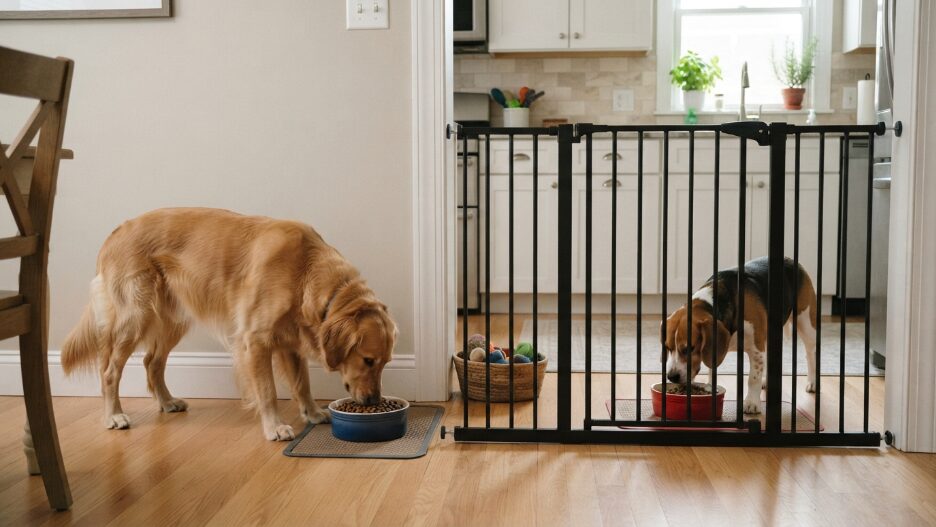
If your dog is food aggressive with other dogs, the first and most important step is complete physical separation at every mealtime. Full stop. Not across the room, not with an owner standing between them. Separate rooms, or crates with doors closed, or baby gates with enough distance that neither dog can see the other’s bowl.
This is not a permanent arrangement in all cases, but it is the right arrangement until the issue is assessed and addressed. Many multi-dog households simply maintain mealtime separation permanently, which is a perfectly reasonable management strategy if the dogs are otherwise compatible. The separation itself removes the trigger entirely. No competition, no guarding, no conflict.
- Feed at the same time each day. Routine reduces anticipatory arousal. Dogs that know when food is coming approach mealtime with less anxiety.
- Use identical bowls. Dogs are perceptive. Different bowl sizes or positions can create perceived inequity that increases guarding.
- Do not allow access to each other’s unfinished food. Pick up all bowls once both dogs have finished or walked away. Do not allow one dog to approach another’s bowl while food remains.
- Manage high-value items the same way. Chew bones, bully sticks, frozen Kongs, and similar items trigger the same dog-to-dog guarding response as the food bowl. Give these only in separated spaces.
- Watch body language during the post-meal window. Food aggression between dogs can continue for 10 to 15 minutes after the bowls are gone. The guarding state does not shut off instantly when the food is removed.
When the Two-Dog Dynamic Involves Serious Aggression
Dog-to-dog food aggression that has escalated to actual fighting is a safety situation that goes beyond what standard management advice can adequately address. The combination of resource competition and inter-dog social dynamics is complex, and the risk of serious injury to one or both dogs is real.
If your dogs have fought over food, the immediate response is complete, permanent separation during all feeding, chewing, and high-value item scenarios. Not supervised feeding with both present. Separated. Then assess whether the relationship between the dogs requires professional evaluation and intervention.
What Not to Do: Training Mistakes That Turn Mild Food Aggression Into a Serious Problem
The internet is full of advice on food aggression. Some of it is helpful. Some of it is dangerously wrong. Here are the most common mistakes, and the specific reasons each one backfires.
“Dominating” Your Dog Out of the Bowl
The advice to stand over your dog, stare them down, or physically push them away from the bowl to establish yourself as the “alpha” is rooted in a debunked theory of canine social structure and produces predictably bad outcomes. A dog being physically intimidated at their food bowl learns one thing: humans near their food bowl are a source of physical threat. The guarding response intensifies because the threat has been confirmed.
Sticking Your Hand in the Food Bowl While the Dog Eats
This is sometimes recommended as a way to teach the dog that your hand means good things. For a dog that does not have food aggression, it is harmless and probably useless. For a dog that does, it is pushing them into a defensive state during every single meal. You are not desensitizing them. You are practicing the trigger repeatedly with no counter-conditioning element. The dog gets more guarding practice, not less.
Punishing Growling or Stiffening
This deserves repeating because it is the most dangerous mistake on the list. Punishing a dog for growling creates a dog that bites without warning. The growl is the warning. Suppress the warning, and the bite arrives unannounced. The American Veterinary Medical Association, the ASPCA, and every major animal behavior organization are unequivocal on this point: removing warning signals from a fearful or guarding dog increases the risk of biting.
Attempting to Handle Severe Food Aggression Alone
At Levels 3 and 4 on the severity scale, specifically when snapping and biting have occurred, working on food aggression through home protocols alone places you and your family at real physical risk. The behavior modification process for a dog at this level requires a professional who can physically read the dog’s body language in real time, adjust the protocol immediately based on the dog’s response, and manage the safety of everyone in the room. This is not a DIY situation.
When to Call a Dog Trainer for Food Aggression: And What to Look For
Knowing when to stop trying to manage food aggression on your own and when to call a professional is one of the most important judgment calls a dog owner can make. Here is a clear framework.
You Should Seek Professional Help When:
- Your dog has already snapped or made contact biting over food, even once
- The food aggression is directed at a child or elderly person in the household
- The guarding behavior has expanded from food to include multiple resources: toys, furniture, specific rooms, or people
- You have been working at this for six to eight weeks without measurable improvement
- The dog guards dropped food, counter-surfaced items, or any food-adjacent situation, not just the bowl at mealtime
- You feel genuinely afraid to approach the dog during feeding
- The behavior appeared suddenly and your vet has cleared a medical cause
What to Look for in a Dog Trainer for Food Aggression
Not every dog trainer has the experience or the methodology to work with food aggression safely and effectively. When looking for professional help, these are the credentials and approaches that matter.
- Certified Professional Dog Trainer (CPDT-KA) or higher. This credential requires demonstrated knowledge and experience. It is not a guarantee of competence with aggression specifically, but it is a meaningful baseline.
- Certified Applied Animal Behaviorist (CAAB) or Veterinary Behaviorist (Dip. ACVB). For severe cases involving biting, these are the highest-level credentials available. A veterinary behaviorist is a licensed veterinarian with a board-certified specialty in animal behavior. These professionals can also prescribe medication if anxiety is a significant component of the problem.
- Force-free or positive reinforcement-based methodology. Trainers who use aversive corrections on food-aggressive dogs regularly produce worse outcomes. Punishment-based approaches elevate stress around food, which is the exact condition that drives food aggression. Look for a trainer who uses desensitization, counter-conditioning, and management-based approaches.
- Transparent about limitations. A good trainer will tell you honestly when a case is beyond their scope. That kind of transparency is a sign of professionalism, not weakness.
| Our Honest Position on Aggressive Dogs at Dan Gentile Dog Training Center: We are committed to being straightforward with every owner who contacts us. Dan Gentile Dog Training Center does not train dogs with confirmed aggression in our board-and-train facility. The reason is simple: the safety of our staff and the other dogs in our care comes first. A board-and-train environment involves group handling, staff interactions during feeding, and close proximity to other dogs, exactly the scenarios that create serious risk with a food-aggressive dog. This is not a limitation we apologize for. It is a responsible boundary that protects everyone involved. If your dog has moderate to severe food aggression, the right resource is a certified applied animal behaviorist or a veterinary behaviorist who can conduct individual, controlled behavior modification in a dedicated setting. We can help you find the right referral. |
Preventing Food Aggression From Developing in the First Place
If you have a puppy, or a dog that has not yet shown food aggression, the most valuable thing in this article is this section. Prevention is dramatically easier than treatment, and the window for establishing healthy food associations is wide open right now.
The Early Mealtime Habits That Build Food-Confident Dogs
The goal of early mealtime conditioning is to teach your puppy that humans near their food bowl are a source of additions, not subtractions. Every positive mealtime interaction builds the opposite of guarding instinct.
- Approach the bowl calmly and drop something better in it. Do this at every meal, starting from the first week. Walk to the bowl, drop a small piece of chicken or cheese in it, and walk away. The lesson: a human approaching during mealtime means a bonus is coming. This is the opposite of the lesson that creates food aggression.
- Practice calm handling during meals. Gently touch the puppy’s body, back, and shoulders while they eat, working toward being able to briefly handle the food bowl without any tension developing.
- Teach “leave it” and “drop it” early, before any resource issues develop. These commands, trained with positive reinforcement in relaxed contexts, become automatic responses that override the guarding instinct before it ever has a chance to activate.
- Never tease a puppy with food. Holding food over them, pretending to take it, or repeatedly interrupting meals to test their reaction plants seeds of anxiety around food resources.
- Feed scheduled meals, not free-feed. Structured mealtimes establish a predictable routine that reduces anticipatory anxiety and gives you regular, built-in opportunities to practice the positive approach exercises above.
Socialization Around Food in Multi-Dog Households
If you are bringing a new dog into a household that already has a dog, introduce the feeding dynamic carefully from the start. Feed dogs in separate spaces from day one, even if neither dog shows any guarding behavior. Establish the habit early and maintain it.
Reward both dogs for calm behavior in proximity to each other outside of mealtime. Build positive associations between the dogs in contexts that have nothing to do with food, so the overall relationship is warm and trusting before food enters the picture. A strong inter-dog social bond does not eliminate food competition, but it does reduce the intensity of the guarding response.
For more guidance on building a well-socialized, confident dog from the ground up, see our puppy training program. And if you are dealing with a broader range of behavioral issues beyond food, our behavior modification program explains what a professional assessment and plan can address.
How Dan Gentile Dog Training Center Supports Responsible Dog Ownership in New Jersey
At Dan Gentile Dog Training Center in Howell Township, Monmouth County, NJ, we have been working with New Jersey dog owners for more than 40 years. In that time, we have seen what responsible early training does for the long-term behavioral health of a dog, including the prevention of resource-guarding behaviors that so often develop in dogs with no foundational obedience structure.
Our programs are not right for every dog. We believe in being honest about that. What we do exceptionally well is build the foundational obedience, impulse control, and human-trust relationship that makes dogs easier to live with, safer around people, and far less likely to develop the resource-based behavioral issues that bring many owners to their wits’ end.
| Train While Boarding Foundational Obedience: That Addresses the Root of Many Behavior Problems. The Train While Boarding program builds the impulse control, command reliability, and handler focus that underlie good behavior across all contexts. A dog with solid obedience foundations, reliable sit, stay, leave it, drop it, recall has the behavioral vocabulary to navigate situations that would trigger an untrained dog into resource guarding. Prevention through training is almost always easier and safer than behavior modification after the fact. |
| Puppy Training: Build the Food-Confident Dog You Want From Day One. The optimal window for building healthy food associations, strong impulse control, and a trusting relationship with handling is during puppyhood. Dan Gentile’s puppy program in Monmouth County covers socialization, foundational commands, mealtime behavior, and the early habits that prevent resource guarding from ever developing into a problem. |
| Obedience Training: The Commands That Matter Most Around Food and Resources. “Leave it,” “drop it,” and a reliable recall are the three most practical tools for managing food-related situations safely. Our obedience training program builds these commands to a level of reliability that holds up in real-world scenarios, not just in your living room. |
| 40+ Years of Experience: Honest Guidance You Can Trust. Dan Gentile has been training dogs in New Jersey since before most current certification programs existed. That experience means you are getting guidance informed by thousands of real dogs, real situations, and real outcomes. When we tell you that a situation is beyond our scope and refer you to a specialist, you can trust that assessment. When we tell you that training will help, you can trust that too. |
To discuss whether our programs are a fit for your dog’s current needs, call (732) 938-5040 for a free consultation or explore our obedience training options, puppy training program, and board and train program online. You can also contact us directly here.
Frequently Asked Questions About Dog Food Aggression
Is food aggression in dogs the same as resource guarding?
Food aggression is a specific type of resource guarding. Resource guarding is the broader category: any behavior in which a dog protects something they value from perceived competition. Food is simply the most commonly guarded resource. A dog can resource guard toys, resting spots, a specific person, or even a room in the house.
Food aggression refers specifically to guarding behavior triggered by food. Both involve the same underlying mechanism: the dog believes the resource is at risk and uses threatening behavior to protect it.
Can food aggression in dogs be cured completely?
Mild to moderate food aggression can be significantly reduced through consistent desensitization and counter-conditioning, often to the point where it is no longer a practical concern in daily life. Whether it is “cured” in an absolute sense depends on how you define the term.
The underlying instinct to guard food does not disappear from the dog’s neurological wiring. What changes is the emotional association with people or other animals approaching during mealtime, from threat to benefit. Well-managed and well-trained, most dogs with mild to moderate food aggression can become entirely safe and relaxed at mealtime.
Severe food aggression with a biting history requires professional behavior modification and may require ongoing management for the life of the dog.
My dog growls when I walk near their bowl but has never snapped. Should I be worried?
Yes, in the sense that growling is a warning signal that should be taken seriously and addressed before it escalates. No, in the sense that a dog that is still at the growling stage has not yet learned that escalating to a snap or bite is effective. This is the ideal intervention point.
A dog that growls but has never snapped is telling you clearly what their threshold is. Respect it, do not try to punish it away, and begin the desensitization protocol described in this article. If you are not comfortable working through it alone, consult a professional sooner rather than later.
At what age does food aggression typically start?
Food aggression can appear at any age, but it commonly shows up in two windows: early adolescence, around four to eight months of age, as the dog’s independence and resource awareness increases; and in adulthood, triggered by a change in household dynamics such as the addition of a new dog, a new baby, or a significant change in feeding routine. In puppies from communal feeding environments, guarding behavior can be present from the earliest weeks. Sudden onset of food aggression in a previously relaxed adult dog warrants veterinary evaluation to rule out pain or illness.
Is it safe to have children around a food-aggressive dog?
Not without strict management protocols in place. Children are at significantly higher risk from food-aggressive dogs because they are less able to read warning signals, more likely to approach a dog during eating without understanding the risk, and their face level is closer to the dog’s head.
Until food aggression is fully resolved through professional guidance, the rule should be absolute: children and the food-aggressive dog are never in the same space during mealtimes or when the dog has any food item. This is non-negotiable. If you have young children and a dog with confirmed food aggression, professional assessment should happen immediately, not eventually.
Does spaying or neutering affect food aggression?
Spaying and neutering can reduce some forms of aggression linked to hormonal influence, but food aggression is not primarily a hormonally driven behavior. It is a learned and instinctive response rooted in resource competition anxiety.
Spaying or neutering your dog is recommended for many reasons, but expecting it to resolve food aggression is not accurate. Behavior modification is the relevant intervention for food aggression, regardless of reproductive status.
How do I find a qualified professional to help with food aggression?
For mild to moderate food aggression, look for a Certified Professional Dog Trainer (CPDT-KA) with documented experience handling resource guarding cases. Ask specifically about their methodology: you want a force-free, desensitization and counter-conditioning approach.
For severe cases involving snapping or biting, seek a Certified Applied Animal Behaviorist (CAAB) or a board-certified Veterinary Behaviorist (Dip. ACVB). Your veterinarian can provide referrals to both. The IAABC (International Association of Animal Behavior Consultants) and the Animal Behavior Society also maintain searchable directories of certified professionals.
The Bottom Line on Dog Food Aggression: Understand It, Respect It, Address It Early
Dog food aggression is not a character flaw, a training failure, or a sign that your dog is unlovable. It is an ancient instinct that made perfect sense in an ancient world and creates a real problem in a modern one. The dogs that develop it are not broken. They are operating exactly as their nervous systems were designed to operate. They just need help building a different set of associations around food and the people near it.
The most important things to take away from this guide are these: intervene early, before mild guarding becomes entrenched behavior. Respect the growl as communication rather than punishing it out of existence. Use management to prevent incidents while training is in progress. And be honest with yourself about the severity of what you are dealing with.
Mild food aggression, caught early and handled correctly, is a very manageable problem. Severe food aggression with a biting history is not a home project. Knowing which situation you are in, and responding accordingly, is what keeps dogs and people safe.
If you are in New Jersey and looking for an experienced trainer to discuss your dog’s foundation obedience needs, mealtime behavior, or general behavioral health, the team at Dan Gentile Dog Training Center in Monmouth County is happy to have that conversation. We will give you an honest assessment of what we can help with and a clear referral when the situation calls for a different specialist.
Call (732) 938-5040 today for a free consultation.