How to Potty Train a Puppy in 7 Days: A Professional Trainer’s Day-by-Day Blueprint
Your new puppy just had another accident on the living room carpet. It is the third one today, and you are starting to wonder if potty training will ever click. Sound familiar? You are not alone, and the good news is that a structured seven-day plan can transform your frustrated mornings into a smooth, predictable routine.
At the Dan Gentile Dog Training Center in Howell, New Jersey, we have helped more than 2,500 families potty train their puppies over the last four decades. Our approach is built on one simple truth: puppies learn best when their world feels predictable. Give them a clear routine, remove the chance for mistakes, and reward every success. That is the formula.
This guide teaches you exactly how to potty train a puppy in 7 days using the same step-by-step blueprint our trainers use at our facility. It is not a theory. It is a real plan, broken down day by day, so you always know what to do next. You will also learn the four core principles that make the whole process work, plus what to do when things go sideways.
Grab a small notebook, a bag of treats, and a little patience. Your puppy is about to learn the most important habit of their life.
Quick Overview: How to Potty Train a Puppy in 7 Days
Potty training a puppy in 7 days comes down to four pillars: strict supervision, consistent scheduling, positive reinforcement, and calm accident management. On Days 1 and 2, you take your puppy outside every 30 to 45 minutes and reward every outdoor success. On Days 3 and 4, you stretch intervals to 45 to 60 minutes and start reading your puppy’s bathroom signals. On Days 5 and 6, you introduce short windows of supervised freedom in one room. On Day 7, you review your notebook, identify your puppy’s natural rhythm, and build a long-term routine around it.
The approach relies on a properly sized crate, enzyme cleaner for accidents, and a designated outdoor potty spot. It works for most breeds and ages, though puppies younger than 8 weeks lack the bladder control needed for structured training. According to the American Kennel Club, puppies can generally hold their bladder for one hour per month of age, so a three-month-old puppy maxes out around four hours.
If your puppy has already been through initial training and recently started having accidents again, that is a separate issue called potty training regression. Our full guide on that topic is available on the blog.
Before You Start: Setting Up for a Successful Week
Potty training is much easier when you prepare your home before Day 1. Think of it like meal prep for the week: a little effort upfront saves you hours of stress later. Puppies learn best when their environment feels calm, consistent, and structured. A chaotic house with open rooms and scattered supplies leads to more accidents and more frustration.
Choosing the Right Crate
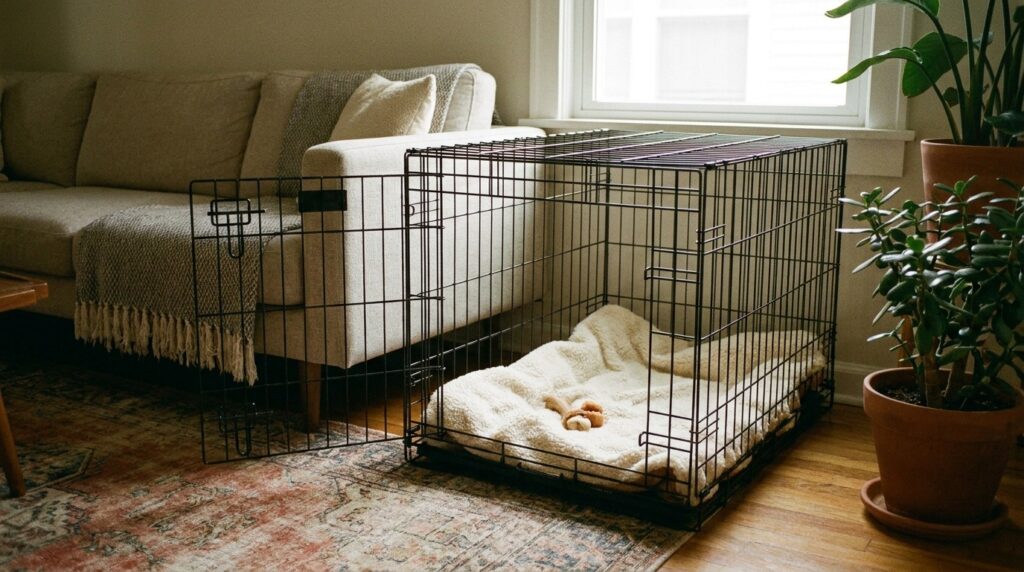
The crate is your most powerful potty training tool. Puppies instinctively avoid soiling their sleeping area, so a correctly sized crate teaches them to hold it until you take them outside. The crate should be just big enough for your puppy to stand up, turn around, and lie down comfortably. Nothing bigger.
If the crate is too large, your puppy will sleep on one end and use the other corner as a bathroom. Many crates come with a movable divider, which lets you adjust the space as your puppy grows. This way, you buy one crate and resize it over time instead of purchasing three different ones.
Gathering Your Supplies
Here is what you need before Day 1:
- A properly sized crate (with a divider if possible)
- A regular leash and a well-fitted harness
- Small, soft training treats
- An enzyme-based cleaner (regular cleaners mask the smell, but enzyme cleaners break it down completely, which prevents your puppy from returning to the same spot)
- Baby gates or a puppy playpen to block off unsupervised rooms
- A small notebook or phone app for tracking potty trips
You do not need anything fancy. No indoor grass pads, no bell-training kits, no elaborate setups. The basics listed above are everything a professional trainer would use.
Preparing Your Home Environment
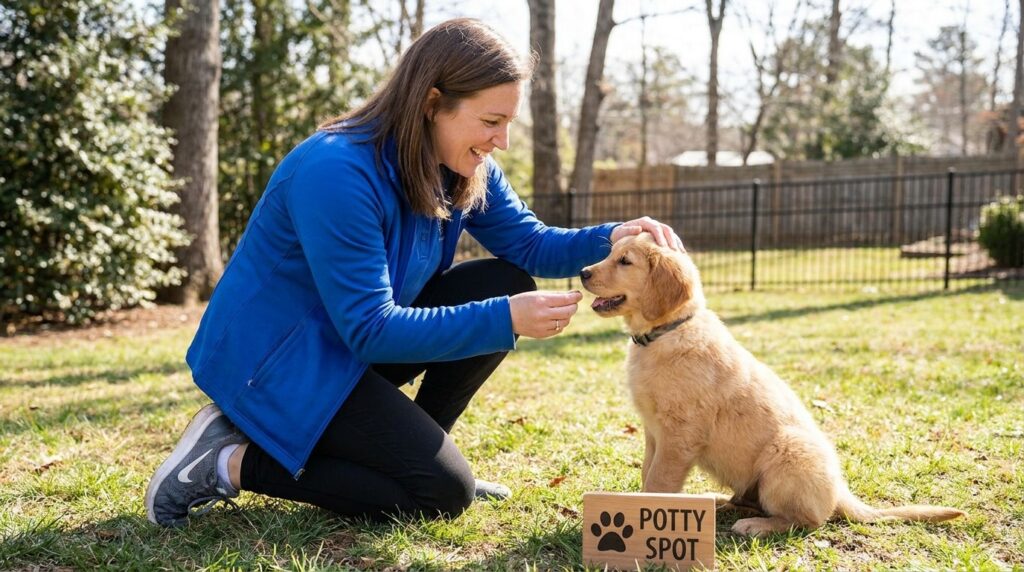
Pick one outdoor spot and commit to it. This is your puppy’s designated potty area. Take them to this same place every single time. The familiar scent of previous trips helps your puppy understand what is expected the moment their paws hit that ground.
Inside your home, close off any rooms you cannot actively supervise. Roll up expensive rugs for the next few weeks. Puppies gravitate toward soft surfaces, and an area rug is one of the most common accident spots. Set up the crate in a room where you spend the most time, like your kitchen or living room, and add a soft blanket or towel inside to make it comfortable.
Understanding the Puppy Bladder Cycle
Young puppies have small bladders and very little control over them. Most puppies need to go after waking up, after eating, after playing, and every one to two hours in between. Very young puppies may need to go even more frequently.
Start learning your puppy’s early warning signs right away. Sniffing the floor, circling, pacing, whining, or walking toward a corner all signal that a bathroom trip is coming. The faster you recognize these cues, the fewer accidents you will clean up.
One more thing: puppies do not have accidents on purpose. They simply have not developed the muscle control or the learned habit yet. Patience is not optional here. It is the foundation.
The 4 Pillars of Puppy Potty Training Success
At the Dan Gentile Dog Training Center, we teach every puppy owner four foundational principles before they start the 7-day plan. These four pillars are not tips or tricks. They are the framework that holds the entire process together. Miss one, and the plan breaks down. Follow all four, and potty training becomes far simpler than most people expect.
Pillar 1: Strict Supervision (The “Eyes-On Rule”)
This is the single most important rule in potty training. If your eyes are directly on your puppy, they can be out of the crate or pen. If you cannot watch them, not even for a minute, they go back into their safe space.
Being in the same room is not the same as supervising. You cannot truly watch your puppy while cooking dinner, answering a work call, or scrolling through your phone. Puppies are fast. Accidents happen in seconds. One quick squat behind the couch, and the damage is done.
This rule feels strict, and it is. But it prevents the vast majority of indoor accidents before they ever happen. Supervision is the wall that keeps your puppy from practicing the wrong behavior.
Pillar 2: Consistent Scheduling (“Beating the Bladder”)
Instead of waiting for your puppy to signal that they need to go, you stay one step ahead. We call this “Beating the Bladder.” You take them outside before they get desperate.
Your puppy needs to go outside:
- Right when they wake up (morning and after every nap)
- Right after every meal
- Right after playtime
- Every 30 to 60 minutes during the day (depending on the training phase)
- Right before bed
Frequent trips give your puppy plenty of chances to succeed and very few chances to fail. You are training their body to develop a rhythm, and that rhythm only forms through repetition.
Pillar 3: Positive Reinforcement (The “Potty Party”)
This is the fun pillar. The moment your puppy finishes going potty outside, you celebrate. Not when you get back inside. Not five minutes later. Right there, at the potty spot, the instant they finish.
Use a happy, upbeat voice. Give them a small treat. Make the experience feel like a victory. Puppies repeat behaviors that feel rewarding, and you want going potty outside to feel like the best thing that happened all day.
Timing matters enormously here. A treat delivered three seconds after the act is ten times more effective than a treat delivered thirty seconds later. Your puppy connects the reward with whatever just happened, so speed is everything.
Pillar 4: Accident Management (The “No-Blame Rule”)
Accidents will happen. Your response to those accidents shapes the entire training process.
Never punish your puppy for an accident. Do not yell, do not grab them, do not rub their nose in it. Punishment does not teach a puppy where to go. It teaches them to be afraid of going in front of you, which means they will start hiding behind furniture to relieve themselves. That is the opposite of what you want.
If you catch them in the act, stay calm. Say a quick “Oops!” to interrupt them, scoop them up, and carry them outside to the potty spot. Let them finish there, and then celebrate. If you find an accident after the fact, you missed it. Clean it up quietly with enzyme cleaner and move on. The teaching moment has passed.
These four pillars work as a team. Supervision prevents most accidents. Scheduling creates the rhythm. Positive reinforcement teaches your puppy what to do. And accident management keeps the process moving forward without fear or confusion.
The 7-Day Puppy Potty Training Blueprint
This is the core of the plan. For the next seven days, you will follow a structured routine that teaches your puppy when and where to go potty. Each phase builds on the one before it. The habits you create this week will last for years.
Gather your crate, treats, leash, enzyme cleaner, and notebook. Keep them within arm’s reach all week. You are about to become very familiar with your backyard.
Pre-Day 1: Set Up Your Home
Pick your puppy’s outdoor potty spot. Walk over to it and memorize the path, because you will be taking that walk dozens of times this week.
Set up the crate in your main living area. Add a soft blanket. Use baby gates to block off any room you cannot supervise. If you have area rugs in high-traffic zones, roll them up. Puppies love soft surfaces, and a rug that smells even faintly of a previous accident becomes a magnet.
Fill a small treat bag and clip it near the back door. You need treats accessible in under three seconds. That speed matters.
Days 1 and 2: The Intensive Start
Your goal is simple: prevent as many accidents as possible and teach your puppy the new routine. These two days will feel busy, but they set the foundation for everything that follows.
Take your puppy outside every 30 to 45 minutes. Yes, it is a lot. But this frequency keeps your puppy from guessing and gives them constant opportunities to succeed.
Here is the routine you will repeat all day:
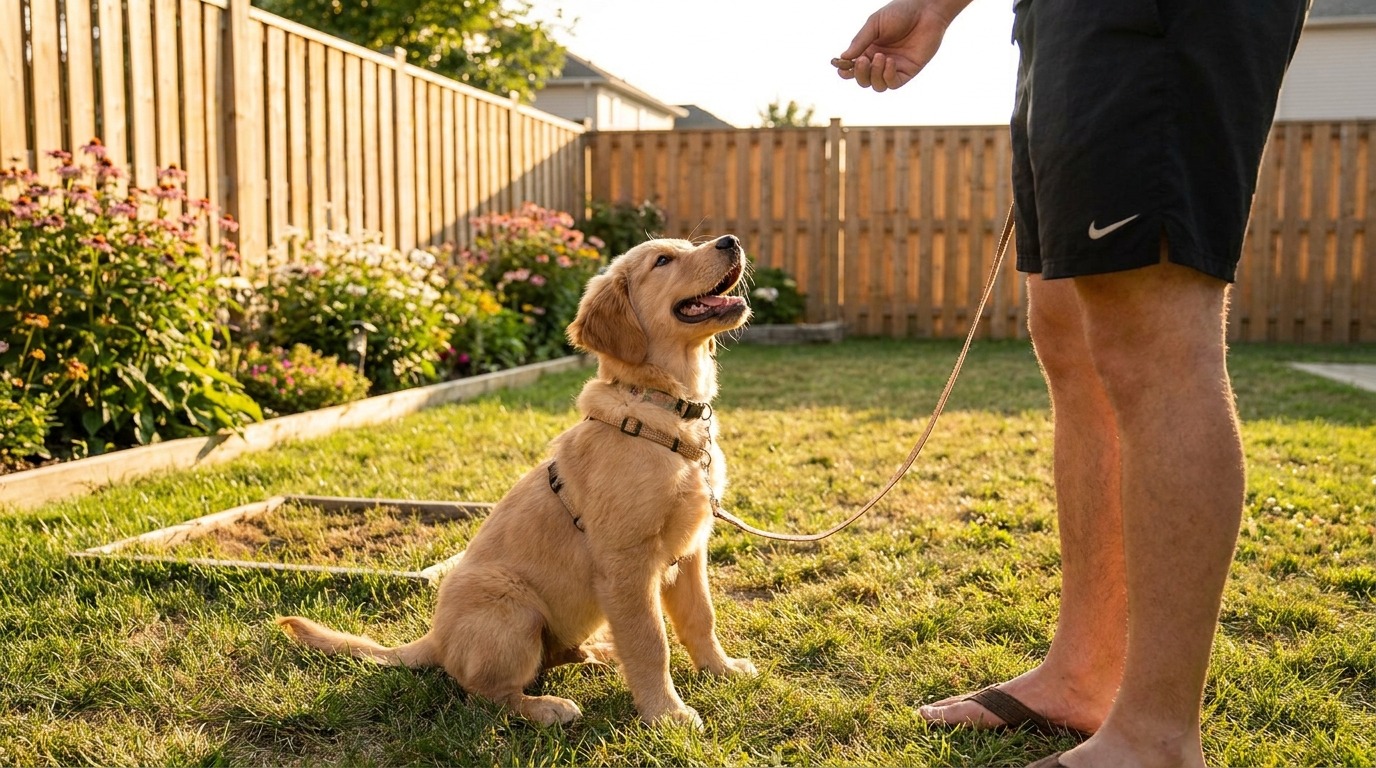
1. Pick your puppy up and carry them straight to the potty spot the moment they wake up.
2. Put them down on their leash and wait quietly. This is not playtime.
3. Say your cue word once. Something simple like “Go potty” or “Get busy” works well.
4. Give them up to five minutes. Stand still and stay calm. No talking, no petting.
5. The moment they finish, throw a Potty Party. Happy voice, treat, praise. Right there at the spot.
6. Go back inside and give them 15 to 20 minutes of supervised playtime.
7. After playtime, back into the crate or pen for a rest period.
8. Repeat the entire cycle every 30 to 45 minutes.
In addition to these scheduled trips, take your puppy out after every meal, every nap, and right before bed. Write down every single potty trip in your notebook, including the time and the result. This data becomes critical on Day 7.
Days 3 and 4: Building the Routine
Your puppy has had two full days of the new schedule, and patterns are starting to form. Now you can stretch the intervals slightly.
If your puppy is doing well with few or no accidents, try spacing potty trips to every 45 to 60 minutes. Keep the same routine: carry them out, cue word, wait, celebrate success, supervised play, back to the crate.
This is also when you start paying close attention to your puppy’s body language. Look for sniffing the floor, circling, whining, or walking toward the door. These are bathroom signals. When you spot one, calmly say “Oops!”, pick your puppy up, and head straight outside.
Supervision stays tight during this phase. Your puppy should be in one of three places at all times: in the crate, in the pen, or right next to you with your full attention. There is no “sort of watching” during these days.
Days 5 and 6: Earning a Little More Freedom
If things have been going well, your puppy can now earn small windows of supervised freedom. After a successful potty trip outside, let them explore one puppy-proofed room for 20 to 30 minutes. You still watch them the entire time. This is not free time for you. It is supervised exploration for them.
If your notebook shows consistent success, you can stretch potty trips to every 60 to 90 minutes. Only do this if the data supports it. Do not guess. Check your notes.
If you cannot actively supervise, your puppy goes back to the crate or pen. Freedom is a reward for an empty bladder, not a default setting.
Day 7: Reviewing Your Routine and Looking Ahead
Open your notebook and look for patterns. At this point, you should see a clear rhythm. Maybe your puppy needs to go every 90 minutes. Maybe every two hours. Maybe they always go within 10 minutes of eating. These patterns are your new schedule.
You still take them out after waking, eating, playing, and before bed. But the trips in between now follow your puppy’s natural rhythm instead of a rigid timer.
Do not stop the Potty Parties today. Treats and praise still matter. Your puppy is still learning and still needs that reinforcement to lock in the habit.
On this day, you should feel a real shift. You and your puppy now understand each other. The routine that felt exhausting on Day 1 now feels natural. That is exactly how it is supposed to work.
Potty Training Troubleshooting: A Professional Trainer’s Answers
Even with a solid plan, bumps will appear. That is completely normal. Puppies are learning, and learning is never a straight line. Here are the most common situations we hear about at the Dan Gentile Dog Training Center, along with what to do about each one.
My Puppy Pees in the Crate
The first thing to check is crate size. If the crate gives your puppy enough room to sleep on one side and potty on the other, it is too big. Adjust the divider so the space is snug.
If the size is correct, look at your schedule. Your puppy may need more frequent trips outside. Many young puppies cannot hold it as long as owners expect. Also, make sure you are cleaning the crate thoroughly with enzyme cleaner. If your puppy smells old urine on the bedding or tray, they may treat that spot as an acceptable bathroom.
I Caught My Puppy Having an Accident Indoors
This is actually a teaching moment. Stay calm. Make a quick, gentle sound like “Oops!” or give one small clap. Your goal is to interrupt the flow, not terrify your puppy.
Once they pause, pick them up and carry them straight to the outdoor potty spot. Let them finish there. When they do, celebrate with a treat and praise. This teaches your puppy that the interruption was just a redirect, not a punishment.
I Found a Puddle but Did Not See It Happen
If you did not witness the accident, you cannot teach anything in that moment. Do not scold your puppy. They will not connect your frustration with something that happened minutes or hours ago.
Clean the spot with enzyme cleaner and remind yourself to supervise more closely. This was a supervision gap, not a “bad” puppy.
My Puppy Goes Outside and Then Has an Accident Indoors Five Minutes Later
This usually means your puppy did not fully empty their bladder outside. Puppies get distracted by sounds, smells, and movement. They start to go, stop to investigate a leaf, and come back inside with a half-full bladder.
The fix: stay outside a little longer. Do not talk, play, or walk around. Just stand quietly at the potty spot and give your puppy time to fully finish. Once they go, praise them, and then begin playtime or go inside.
It Is Raining or Snowing and My Puppy Refuses to Go Out
Bad weather is tough on puppies, but they still need to learn that potty happens outside regardless of conditions. Grab your umbrella, stay calm, and walk to the same potty spot.
It may take longer than usual. That is fine. When your puppy finally goes, celebrate like it is the biggest accomplishment of the day. Pull out the best treats you have. You want your puppy to associate going potty in bad weather with an extra-special reward.
My Puppy Pees When Excited or Nervous
This is called excitement urination or submissive urination, and it is not a potty training problem. Your puppy cannot control this response. It is an involuntary physical reaction.
Keep your arrivals low-key. Do not rush in and greet your puppy with a high-pitched voice and big movements. Keep things slow and calm. Ask guests to do the same. Most puppies outgrow this as their confidence and bladder control improve with age.
Beyond Day 7: Maintaining Your Puppy’s Potty Training Success
You made it through the seven-day plan. That is a real accomplishment, and you should feel proud. Your puppy has already built strong habits, and your home is much cleaner than it was a week ago.
But potty training does not end on Day 7. Your puppy is still young, and their brain and bladder are both still developing. Think of the next phase as maintenance. You are keeping the good habits locked in while gradually giving your puppy more independence.
Expect a Setback (And Know How to Handle It)
It is completely normal for a puppy to have an accident even after doing well for weeks. This is called potty training regression, and almost every puppy goes through it. Maybe they drank more water than usual. Maybe a growth spurt changed their bladder capacity. Maybe a new sound in the house threw off their routine.
Do not panic. Go back to the No-Blame Rule. Clean the accident with enzyme cleaner, stay calm, and keep following your routine. A single setback does not erase a week of progress.
The 3-Day Reset
If you notice more than one accident in a single day, it is time for a tune-up. Go back to the Day 1 and Day 2 schedule for three full days: take your puppy out every 30 to 45 minutes, watch them closely, use the crate between play sessions, and throw a Potty Party for every outdoor success.
After three solid days of success, return to your normal routine. This reset reminds your puppy of the rules and gets everything back on track quickly.
Fading the Crate Gradually
Your puppy has earned more freedom, but give it to them in small steps. For the next few weeks, the crate is still the default whenever you cannot actively supervise. When you are home and attentive, let your puppy explore one room at a time. If they go a few weeks accident-free in that room, open up a second one. Expand their world slowly, and pull back if an accident happens in a new area. Crate training for housebreaking remains one of the most reliable tools even after your puppy graduates from the 7-day plan.
Nighttime Potty Training
Most young puppies cannot hold it all night. For the first few weeks, plan on at least one nighttime trip outside. Keep the crate in your bedroom so you can hear your puppy fuss when they need to go.
When they wake up, pick them up, carry them to the potty spot, let them go, and bring them right back inside. Keep everything quiet and boring. No lights, no talking, no play. You do not want your puppy thinking 3 a.m. is party time.
As your puppy grows, their bladder grows with them. You can set one nighttime alarm and push it later by 15 minutes every few days. Eventually, you will wake up and realize your puppy slept through the entire night. And so did you.
Dan Gentile Dog Training Center: 40+ Years of Proven Puppy Training Results
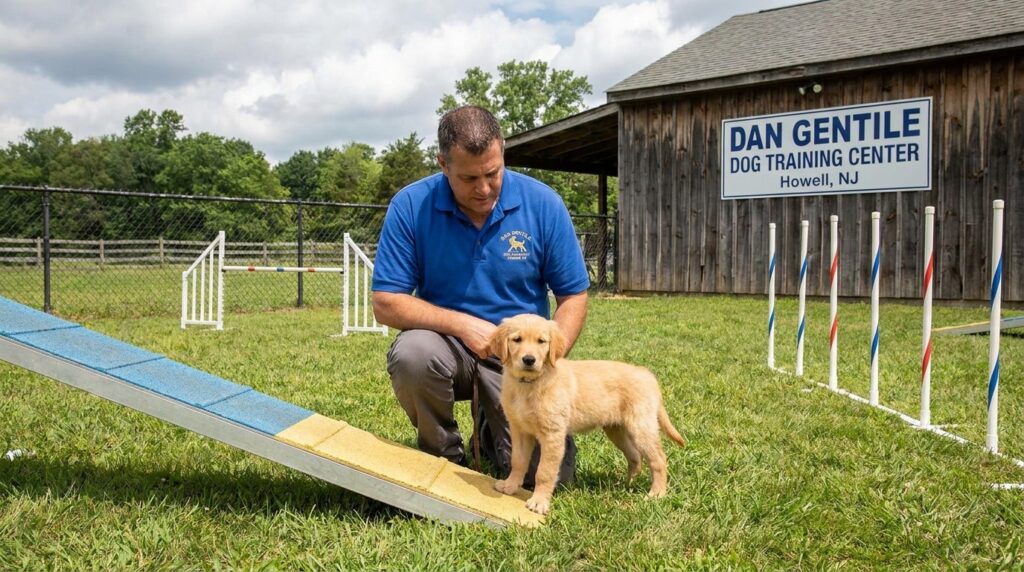
Dan Gentile Jr., one of America’s most experienced professional dog trainers and behaviorists, built the Dan Gentile Dog Training Center from the ground up in Howell Township, Monmouth County, New Jersey. The 12-acre facility has been the training home for over 2,500 dogs and has earned a 4.3-star Google rating from families across 13 New Jersey counties.
Dan apprenticed under some of the top dog handlers in both the United States and Europe. His education includes studies with the U.S. Armed Forces Institute, Cornell University School of Veterinary Medicine, and Ontario Veterinary College. That combination of hands-on mentorship and academic training is rare in the dog training industry, and it shows in the results his team produces.
The center offers a range of programs designed for every stage of a dog’s life, from puppy training starting at 3.5 to 4 months old to advanced obedience training, behavior modification, and the popular board and train boot camp where dogs live at the facility and receive daily professional instruction. All obedience training comes with a written guarantee and lifetime follow-up consultations.
What makes this approach different from typical obedience classes or online training programs is the depth of real-world experience behind it. Forty years of working with thousands of dogs across every breed, temperament, and behavioral challenge means there is almost no situation the Dan Gentile team has not handled before. That is the kind of expertise that turns a frustrating potty training problem into a solved one.
Families from across New Jersey, Pennsylvania, and New York travel to the center for training that delivers lasting results. The facility features climate-controlled kennels, secure outdoor training grounds, and 24/7 veterinary access. To learn more or schedule a consultation, visit the contact page or call (732) 938-5040.
Frequently Asked Questions About Potty Training a Puppy in 7 Days
How long does it take to fully potty train a puppy?
Most puppies develop reliable habits within four to six months, according to general veterinary guidance. The 7-day blueprint establishes the foundation and routine, which is the hardest part. After the first week, you are maintaining and reinforcing habits that are already forming.
What age should I start potty training my puppy?
You can begin structured potty training when your puppy is 8 to 12 weeks old. Puppies younger than 8 weeks do not have enough bladder control for a structured schedule. Starting between 12 and 16 weeks is often ideal because your puppy has better physical control and can hold it slightly longer between trips.
Can I use puppy pads instead of taking my puppy outside?
Puppy pads can slow down house training because they teach your puppy that going indoors is acceptable. If your goal is outdoor potty training, skip the pads and take your puppy directly outside from the start. The 7-day plan works best when there is one clear message: outside is the only place to go.
What if my puppy will not go potty outside?
Stay patient and give them up to five minutes at the potty spot. Keep quiet, avoid play, and let them sniff around. If they do not go, bring them inside and put them in the crate for 10 to 15 minutes, then try again. Some puppies need a few extra attempts before they connect the outdoor spot with bathroom time.
Should I punish my puppy for having an accident?
Absolutely not. Punishment teaches your puppy to fear going potty in front of you, which often leads to hiding behind furniture to relieve themselves. Stay calm, clean the accident with enzyme cleaner, and refocus on supervision and scheduling. Positive reinforcement produces faster, more reliable results than any form of correction.
How do I potty train my puppy at night?
Keep the crate in your bedroom so you can hear your puppy when they fuss. Take them out at least once during the night for the first few weeks. Keep the trip quiet, calm, and boring. As your puppy grows, push the nighttime alarm back gradually until they can sleep through the night.
My puppy keeps having accidents in the same spot. What should I do?
Your puppy is likely smelling traces of old urine or feces. Regular household cleaners mask the smell to humans but not to dogs. Use an enzyme-based cleaner, which breaks down the odor molecules completely. Clean the area thoroughly, and block access to it until the habit is broken.
Is it possible to potty train a puppy in 7 days?
A structured 7-day plan can absolutely establish a strong potty training foundation. Most puppies will show dramatic improvement and far fewer accidents after one focused week. Full reliability takes longer, typically four to six months, but the habits and routine you build during the first seven days are the framework for everything that follows.
Conclusion
Learning how to potty train a puppy in 7 days is not about perfection. It is about giving your puppy a clear, consistent routine that makes the right choice obvious and the wrong choice nearly impossible. The four pillars, the day-by-day blueprint, and the troubleshooting strategies in this guide are the same tools professional trainers rely on every day.
Your puppy wants to get this right. They are not making mistakes to frustrate you. They just need a little structure, a lot of patience, and an owner who celebrates the wins. That is you.
If you ever feel stuck or overwhelmed, remember that help is always available. The team at Dan Gentile Dog Training Center has been guiding families through exactly these moments for over 40 years. Reach out at (732) 938-5040 or visit njdog.com to explore training options that fit your puppy’s needs and your lifestyle. Now go outside with your puppy. You have a Potty Party to throw.
Enjoy This Article? You May Also Like:
- Dog Board and Train vs Private Lessons: An Honest Comparison to Help You Choose
- Dog Food Aggression: What It Really Is, Why It Happens, and How to Handle It Safely
- Hardest Dog Breeds to Train: What Makes Them Difficult and What Actually Works
- Pitbull Training: The Complete Guide to Raising a Confident, Well-Behaved Pitbull